






First Off, What's a Quasar?
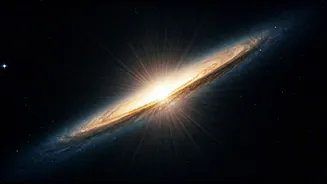
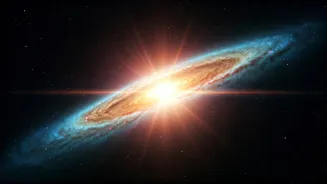
Before we get to the record-breaking discovery, let’s do a quick refresh. A quasar isn't a star, but it's one of the most luminous things in the cosmos. Imagine a supermassive black hole at the center of a very distant galaxy. Now, imagine that black hole is on a cosmic
binge, pulling in an enormous amount of gas, dust, and stars. As this material spirals into the black hole, it forms a massive, superheated disc called an accretion disk. The friction and energy released from this disk are so intense that it shines hundreds of times brighter than its entire host galaxy. A quasar, short for 'quasi-stellar radio source,' is essentially the blindingly bright light show powered by a feeding black hole. It’s less of a 'thing' and more of an 'event'—the spectacular, violent process of a black hole eating its cosmic dinner.
Meet J0529-4351: The Record-Breaker
The newly identified object, named J0529-4351, isn't just another quasar; it's the undisputed champion. Its light has traveled for over 12 billion years to reach us, meaning we're seeing it as it was in the universe's infancy. And it is staggeringly bright—about 500 trillion times more luminous than our sun. If it were in the center of our galaxy, it would outshine the full moon and make the night sky dangerously bright. The engine behind this brilliance is a black hole that's an estimated 17 billion times the mass of our sun. And it's not just massive; it's growing at an unprecedented rate. Scientists, including a team led by the Australian National University with contributions from MIT researchers, calculate that this black hole is devouring the equivalent of one sun's worth of mass every single day. This rate is pushing the theoretical limit of how much material a black hole can consume before the sheer radiation pressure from its own brightness blows its 'food' away.
So, Is It Actually 'Flickering'?
The headline's mention of 'flickering' is a bit of a simplification that hints at a fascinating part of the scientific process. Quasars do vary in brightness over time, but the real story here is that J0529-4351 was so intensely bright that for decades, automated sky surveys mistook it for a relatively dim, common star in our own galaxy. It was effectively hiding in plain sight, its extreme nature masking its true identity. It wasn't until scientists at Australia's Siding Spring Observatory used a larger telescope to take a closer look that its true, distant, and quasar-like nature was confirmed. So the 'flicker' wasn't from the quasar itself going on and off like a faulty lamp, but from our own data initially misleading us. The object’s consistent, extreme brightness was the very thing that made it so hard to spot for what it was.
Why This Cosmic Monster Matters
Discovering the 'most' anything in the universe is always exciting, but J0529-4351 is more than just a cosmic trophy. It's a laboratory for understanding the early universe. How did a black hole get so enormous, so quickly after the Big Bang? Finding an object that is growing this fast, and has been for billions of years, challenges our models of galaxy and black hole formation. It suggests that the conditions in the early universe may have allowed for more extreme growth than previously thought. Furthermore, because it’s so bright, J0529-4351 acts as a beacon. Astronomers can use its powerful light to study the otherwise invisible gas clouds floating in the vast space between it and us. As the quasar's light passes through these clouds, the gas leaves a fingerprint on the light spectrum, giving scientists clues about the composition and evolution of the primordial cosmic web.