




From Listening to Investigating
The classic image of the search for extraterrestrial intelligence (SETI) involves giant radio telescopes pointed at the sky, scanning for a deliberate message from a distant civilization. Think of the movie *Contact*. For over 60 years, that has been
the primary model: listen for a signal, a cosmic “hello.” While projects like the Breakthrough Listen initiative continue this vital work, the silence has been, well, deafening. But what if we’ve been looking for the wrong thing? What if, instead of waiting for a broadcast, we could find compelling evidence of life just by looking at a planet’s atmosphere? This shift from passive listening to active, chemical investigation is what’s making the search so interesting right now. We’re moving from archaeology—looking for signs of an intelligent past—to biology, looking for signs of a living present, intelligent or not.
A Telescope That Can Sniff for Life
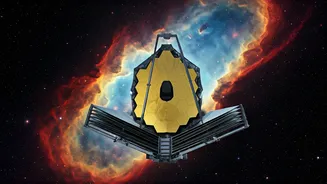
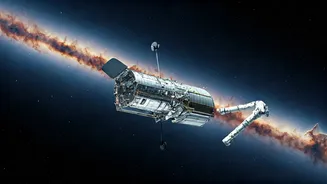
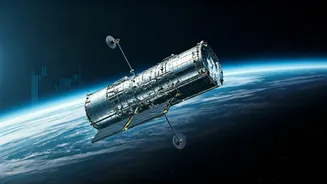
The game-changer is the James Webb Space Telescope (JWST). While the Hubble Space Telescope gave us breathtaking pictures of the cosmos, JWST was designed to do something more. It’s equipped with incredibly sensitive instruments that can perform a technique called spectroscopy. In simple terms, when a planet passes in front of its star, a tiny fraction of the starlight filters through the planet’s atmosphere. JWST can capture that light and break it down, revealing which chemicals are present in that atmosphere. It’s the equivalent of seeing a car’s exhaust from a hundred miles away and being able to tell what kind of fuel it’s running on, how efficient its engine is, and maybe even if it just drove through a farm. By analyzing the “exhaust” of distant worlds, we can look for the chemical fingerprints—or biosignatures—that life might leave behind.
The Chemical Fingerprints of Life
So, what are scientists looking for? They’re not expecting to find a flashing neon sign that says “Aliens Here.” Instead, they’re hunting for biosignatures—gases or combinations of gases that are difficult to explain without a biological origin. On Earth, for example, the sheer amount of oxygen in our atmosphere is a dead giveaway. It’s a highly reactive gas that would quickly disappear if not for the constant replenishment by photosynthetic life (hello, plants and algae). Another key sign would be finding gases that shouldn't exist together, like methane and oxygen. They normally destroy each other, so finding both suggests something is actively producing them. Recently, scientists have become particularly excited about a compound called dimethyl sulfide (DMS). Here on Earth, DMS is produced exclusively by life, primarily marine phytoplankton. Finding it in an exoplanet’s atmosphere would be a stunning, though not yet definitive, sign of biology.
Case Study: The Curious World of K2-18 b
This isn't just theory. In late 2023, this new approach had its first headline-grabbing moment. Using JWST, scientists examined the atmosphere of K2-18 b, a planet about 120 light-years away. It’s a “Hycean” world—a hypothetical type of planet larger than Earth with a hydrogen-rich atmosphere and a massive ocean, potentially conducive to life. The telescope confirmed the presence of methane and carbon dioxide and, tantalizingly, detected a possible hint of dimethyl sulfide. The key word here is *possible*. The data is preliminary and the detection is far from confirmed. Other, non-biological processes might explain the observation, and more analysis is needed to be sure it’s even there. But the mere possibility sent a jolt through the scientific community. It was the first time this new method yielded such a compelling, albeit tentative, clue. The process was working exactly as designed.
It's Not Aliens (Yet)
It’s crucial to pump the brakes. No one is claiming we’ve found aliens. What’s exciting is the refinement of the process. Science, especially at this scale, is a slow, methodical grind of observation, hypothesis, and painstaking verification. The potential detection of DMS on K2-18 b will require years of follow-up observations, not just with JWST but with future telescopes as well. Every alternative explanation must be ruled out. The bar for announcing the discovery of extraterrestrial life is, justifiably, the highest in all of science. What has changed is that for the first time, we have a repeatable, scientific method for clearing that bar. We finally have the tools to ask the right questions and, maybe, understand the answers we get back.