



What Is a Moon Transit?
Before you start tracking, let’s get the terminology straight. A 'transit' is simply when one celestial body passes in front of another from our perspective here on Earth. In this case, we’re talking about one of Jupiter’s moons passing directly between
the planet and us. When this happens, the moon appears as a tiny, dark disk moving slowly across Jupiter's cloudy surface. A related and often more dramatic event is a 'shadow transit,' which occurs when a moon’s shadow is cast onto Jupiter’s cloud tops. Sometimes, you can see both the moon and its even darker shadow transiting at the same time. This is a mini-eclipse on another world, visible from your own backyard. It's a direct, real-time observation of the mechanics of our solar system in motion.
Meet Jupiter's Famous Moons
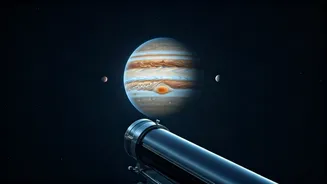
Jupiter has dozens of moons, but four of them are the stars of this show. Known as the Galilean moons—because they were first observed in detail by Galileo Galilei in 1610—they are large enough to be seen with modest binoculars or a small telescope. Their discovery was revolutionary, proving that not everything in the universe orbited the Earth. Get to know the cast: * **Io:** The innermost of the four, Io is the most volcanically active body in the solar system. It zips around Jupiter in less than two days, making its transits frequent and fast. * **Europa:** A favorite of astrobiologists, Europa is a smooth, icy world believed to hide a vast liquid water ocean beneath its crust. * **Ganymede:** The largest moon in our entire solar system—bigger than the planet Mercury! Its transit is a slow, stately affair. * **Callisto:** The outermost of the four, Callisto is a heavily cratered, ancient world. Its long orbit means its transits are less common.
Your Toolkit for Moon-Watching
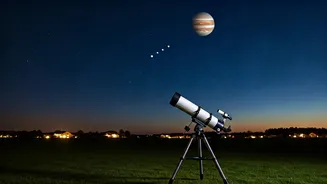
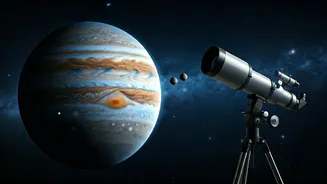
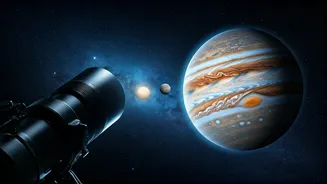
You don't need a research-grade observatory to witness this. The primary piece of equipment is a telescope. While any small telescope will do, one with at least a 4-inch aperture (diameter of the main lens or mirror) will provide a clear, bright view. A steady mount is crucial to prevent frustrating vibrations. Good quality binoculars (10x50 or stronger) mounted on a tripod can also reveal the moons as tiny points of light, though seeing a transit itself will be challenging. The most important tool, however, isn’t optical—it's informational. You need to know *when* to look.
How to Pinpoint the Exact Time
The headline says 'tonight,' but these transits happen on a predictable, continuous schedule. The key is knowing the specific times for your location. Fortunately, technology makes this easy. Don't just go outside and hope; use one of these free resources to get a precise timetable: 1. **Sky & Telescope's Transit Times Tool:** The venerable astronomy magazine offers a free, easy-to-use online utility. Just enter the date, and it will list all the transit events for Jupiter’s moons, automatically converted to your local time. 2. **Stellarium Web:** This is a fantastic, free planetarium in your browser. Go to the website, set your location, and search for Jupiter. Zoom in, and you can move time forward and backward to see exactly when a moon or its shadow will begin its journey across the planet’s disk. 3. **Astronomy Apps:** Mobile apps like Star Walk, SkyView, or SkySafari have features that allow you to simulate the night sky. Like Stellarium, you can center on Jupiter and scrub through time to preview the evening's events.
What You're Looking For
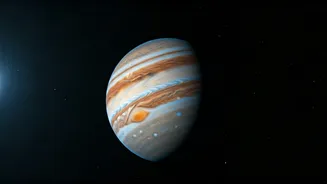
Once you have your time and your telescope is pointed at Jupiter, what should you expect? First, find the planet—it will be one of the brightest objects in the sky. Through the eyepiece, you'll see a brilliant disk, likely with its two main dark cloud bands visible. The moons will appear as sharp, star-like points of light nearby. During a transit, look for a tiny, perfectly round, dark 'pimple' inching its way across the planet's face. A shadow transit is even more striking—a jet-black dot that stands out in sharp contrast against Jupiter’s lighter zones. Be patient. The movement is slow, a full transit can take a couple of hours. But witnessing that slow, steady march is a profound reminder of the vast, clockwork-like nature of our cosmic neighborhood.