








An Underdog Story Decades in the Making
For many Americans, India’s space prowess seemed to appear overnight. In reality, it's the culmination of a long, methodical journey. Founded in 1969, the Indian Space Research Organisation (ISRO) was built on a philosophy of self-reliance and national
development. While the U.S. and Soviet Union were locked in a Cold War space race fueled by colossal budgets, ISRO focused on practical applications, like using satellites for weather forecasting and telecommunications to serve its vast rural population. This history instilled a culture of pragmatism and resourcefulness that defines its work today. It wasn't about planting a flag for prestige alone; it was about building tools for national progress. That foundational mission shaped a unique engineering mindset focused on delivering maximum results with minimal resources.
The Secret Sauce: 'Frugal Innovation'
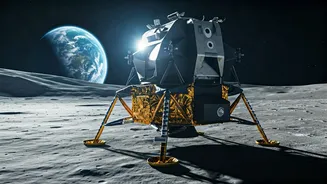
The most headline-grabbing aspect of India’s space program is its astonishing cost-effectiveness. The entire Chandrayaan-3 lunar mission cost an estimated $75 million. To put that in perspective, it’s less than the production budget for Hollywood sci-fi films like *Gravity* or *The Martian*. It's a fraction of the cost of similar missions from NASA or other national agencies. This isn't achieved by cutting corners on safety but through a principle known as "frugal innovation." ISRO engineers are masters of simplifying designs, adapting existing technologies, and meticulously managing supply chains to keep costs down. They prioritize reliability over cutting-edge novelty where possible, iterating on proven systems rather than reinventing the wheel for every mission. This approach has proven that reaching for the stars doesn't have to break the bank, offering a tantalizing model for other aspiring space nations.
More Than Just the Moon
The lunar south pole landing was the watershed moment, but it’s just one part of a much broader expansion. Shortly after its moonshot, ISRO launched Aditya-L1, its first dedicated solar observatory, on a mission to study the sun. Looking ahead, the Gaganyaan program aims to send Indian astronauts into orbit, making India only the fourth country in the world capable of human spaceflight. There are also plans for a mission to Venus and a follow-up to its successful Mars Orbiter Mission from 2014, which famously cost less than the movie *Gravity* as well. This diverse and ambitious pipeline demonstrates that the space boom isn't a one-hit wonder; it's a sustained, strategic push across multiple frontiers of space exploration.
The Private Sector Is Now Taking Flight
Perhaps the most significant long-term driver of India's space boom is the recent opening of the sector to private companies. For decades, ISRO was the only game in town. But in 2020, the government initiated reforms to encourage a domestic version of the U.S. commercial space ecosystem. The result has been an explosion of startups. Companies like Skyroot Aerospace and Agnikul Cosmos are now developing their own rockets, aiming to capture a piece of the lucrative global satellite launch market. This public-private partnership allows ISRO to focus on ambitious deep-space science and exploration, while private firms handle the more routine work of launching satellites into Earth's orbit. This creates a resilient, multi-layered industry poised for exponential growth.
What It Means for the U.S. and the World
So, why does this matter to the United States? For one, India is emerging as a key partner in a new, more multipolar space age. NASA is collaborating closely with ISRO, including on the joint NISAR satellite mission to observe Earth. As a democratic nation, India provides a valuable counterweight to the space ambitions of China and Russia. From a commercial standpoint, India’s low-cost launch capabilities could introduce new competition, but they also promise to democratize access to space, potentially lowering costs for everyone. The "global applause" isn't just polite praise; it's recognition that the future of space exploration will be more collaborative, more competitive, and thanks to India's example, potentially more accessible than ever before.