





Leftovers from a Cosmic Kitchen
Imagine the early solar system as a chaotic construction site. A vast cloud of gas and dust, called the solar nebula, collapsed to form our sun. The leftover material swirled around it in a massive disk, like ingredients in a cosmic mixing bowl. Bits
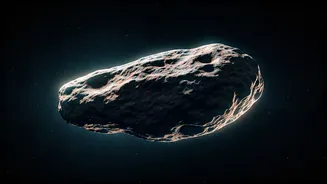
of dust and rock began clumping together, growing larger and larger through gravity. These clumps, known as planetesimals, were the seeds of planets. The ones that grew big enough became Mercury, Venus, Earth, and Mars. The ones that got even bigger, far from the sun, swept up gas to become giants like Jupiter and Saturn. But a huge amount of material never made it into a full-fledged planet. Caught in the gravitational crossfire, especially by the colossal Jupiter, these leftover planetesimals were scattered. They became the asteroids, and because they never underwent the intense heating and geological processing of a planet, their internal chemistry is a near-perfect snapshot of the solar system's starting materials.
The Solar System's Water Delivery Service
One of the biggest questions in planetary science is where Earth got its water. Our planet formed relatively close to the hot, young sun, a region where water ice likely couldn't have survived. So, how did our oceans appear? The leading theory points to the sky. Specifically, it points to water-rich asteroids from the outer, colder parts of the asteroid belt. These 'C-type' (carbonaceous) asteroids are known to contain water locked away inside their mineral structures. Over millions of years, countless asteroids and comets would have impacted the young Earth, acting like a planetary delivery service. Each impact would have deposited its small cargo of water, and over eons, it added up to fill our oceans. Recent analysis of samples returned from asteroids like Ryugu (by Japan's Hayabusa2 mission) and Bennu (by NASA's OSIRIS-REx) has confirmed the presence of water-bearing clay minerals, providing the strongest evidence yet for this cosmic water-bombardment theory.
Searching for the Ingredients of Life
Even more profound than water is the discovery of organic molecules—the carbon-based building blocks of life. This doesn't mean we've found alien microbes on asteroids, but something just as fascinating. Scientists have found a variety of complex organic compounds on meteorites that have fallen to Earth, and now, in pristine samples taken directly from asteroids. The Bennu sample, for instance, is rich in both carbon and water. Analysis of the Ryugu sample revealed more than 20 types of amino acids, the molecules that form proteins. Crucially, it also contained uracil, one of the four essential components of RNA, a cousin of DNA. The fact that these fundamental ingredients for life can form naturally in space and were delivered to Earth along with water suggests that asteroids may have provided our planet with the raw chemical toolkit needed for life to emerge.
Reading the Asteroid Storybook
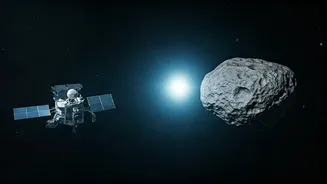
Studying asteroids is a form of cosmic archaeology. For decades, our only access was through meteorites—fragments that survived a fiery plunge through Earth's atmosphere. While valuable, these can be contaminated. That’s why sample-return missions are a game-changer. NASA's OSIRIS-REx mission spent years orbiting the asteroid Bennu before swooping in to collect a sample, which it successfully returned to Earth in 2023. These precious few ounces of rock and dust, protected from earthly contamination, are being analyzed in labs around the world. By studying their composition, isotope ratios, and mineralogy, scientists can reverse-engineer the conditions of the early solar system. They can determine when certain elements formed, how hot the solar nebula was, and how the building blocks of planets were distributed. Each grain of dust is a tiny page in the solar system's autobiography.