



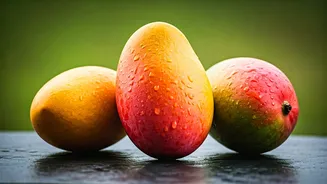
The Reigning King: Alphonso
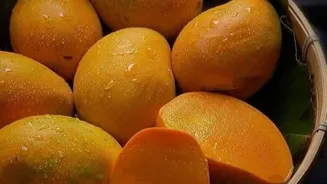
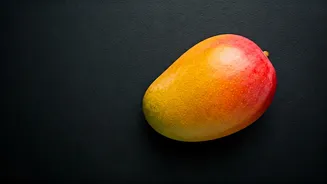
First, you have to understand the incumbent. The Alphonso, or ‘Hapus’ as it’s known in its native Maharashtra, is the mango that launched a thousand ships—or at least, a thousand export deals. It’s the benchmark against which all others are judged. Grown
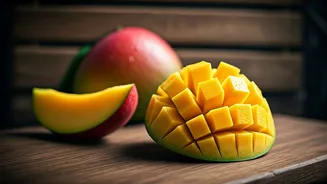
primarily in the coastal Konkan region of western India, the Alphonso is prized for its buttery, non-fibrous texture, a deep saffron-colored flesh, and an intoxicatingly sweet aroma with hints of citrus and melon. It’s so cherished that it was granted a Geographical Indication (GI) tag, a status similar to Champagne in France or Parmigiano-Reggiano in Italy, legally linking its identity to its specific region of origin. For decades, the Alphonso has been India’s premier mango ambassador to the world, commanding high prices and the devotion of millions. It’s not just a fruit; it’s a status symbol.
The Challenger from Gujarat: Kesar
Every king has a primary rival, and for the Alphonso, it’s the Kesar. Hailing from the neighboring state of Gujarat, the Kesar—meaning “saffron”—is named for its intense orange pulp and a fragrance said to evoke the prized spice. While the Alphonso is a decadent dessert eaten on its own, the Kesar is the undisputed champion of pulp. It’s the go-to mango for making *aamras*, a glorious puree that is the highlight of the summer season in Western India. Supporters of Kesar argue it has a more intense, purely sweet flavor profile without the Alphonso’s complex tang. The rivalry is real and promoted heavily. While Alphonso was basking in its royal status, Gujarat secured a GI tag for the “Gir Kesar” mango in 2011, firing a direct shot in the mango wars and officially branding its champion for the national and international stage.
The Pride of the North: Dasheri & Langra
Head north, and the conversation changes completely. Here, the Alphonso is seen as an overpriced, overhyped visitor. The true royalty, they’ll tell you, comes from Uttar Pradesh, the heartland of India’s mango belt. The main contender is the Dasheri, a slender, sweet, and aromatic mango that’s more fibrous than the Alphonso. This isn’t a bug; it’s a feature. The fibers help hold the juices, making for a uniquely satisfying eating experience. Then there’s the Langra, a variety from Varanasi with a greenish skin even when ripe and a legendary, almost mythical, tangy-sweet flavor profile. It has a distinct turpentine-like note in its aroma that aficionados cherish. For hundreds of millions of North Indians, summer doesn’t begin until the Langra and Dasheri arrive, and the idea that some other mango could be “king” is laughable.
The Southern Giant: Banganapalli
While the west and north are locked in battle, the south has its own heavyweight champion: the Banganapalli from Andhra Pradesh. Also known as Benishan, this mango is visually distinct—it’s significantly larger, with a bright, almost canary-yellow skin that is surprisingly thin. Its flavor is milder and less overwhelmingly sweet than its northern counterparts, with a pleasant acidity that makes it incredibly refreshing. It has very little fiber, making it perfect for slicing. Like the others, it boasts its own GI tag, protecting its heritage. The Banganapalli doesn’t compete on the Alphonso’s terms; it dominates its own massive regional market, proving that in a country as vast as India, there can be many kings ruling over their own loyal kingdoms.
What's the 'War' Really About?
This juicy rivalry isn’t just about provincial pride or social media debates. It’s about economics, identity, and legacy. The GI tags are a formal recognition of these long-standing regional claims, protecting farmers and giving them a unique marketing tool. The “war” is fought in newspapers, in marketing campaigns by state agricultural boards, and in heated family arguments every summer. It’s a fight for brand recognition in a booming domestic market and a lucrative international one. For mango lovers, this competition is a blessing. It pushes growers to produce higher-quality fruit and elevates the profiles of lesser-known—but equally divine—varieties that were once only local secrets.