


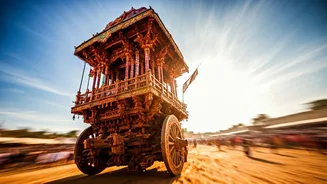

The Festival of Chariots
Rath Yatra, which translates to the “Chariot Journey,” is one of the most important and visually stunning festivals in India. Centered in the coastal city of Puri in the eastern state of Odisha, the event marks the annual journey of three revered deities—Lord
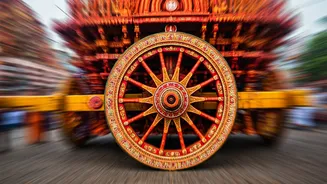
Jagannath, his elder brother Lord Balabhadra, and their sister, Subhadra. For a few days each summer, these gods leave the confines of the sacred Jagannath Temple to travel to their aunt’s temple, the Gundicha Temple, about two miles away. The journey is not a quiet affair. It is a massive, vibrant public procession, where the deities are placed on colossal, ornately decorated wooden chariots and pulled by thousands of devotees using thick ropes. This act of pulling the chariots is considered deeply meritorious, a chance for participants to connect directly with the divine in a powerful display of communal faith.
Meet the Deities of Puri
Unlike the intricate, human-like idols seen in many Hindu temples, the figures of Jagannath, Balabhadra, and Subhadra are distinct and abstract. Carved from sacred wood, they are characterized by large, round eyes, a lack of defined limbs, and bold, blocky colors. Jagannath, whose name means “Lord of the Universe,” is identified by his black face and large circular eyes. His brother Balabhadra is white, and his sister Subhadra is yellow. Their unique forms are tied to local legends and represent a more tribal, folk origin that has been absorbed into mainstream Hinduism. This annual outing is the only time non-Hindus, who are not permitted inside the main temple complex, can have a direct view (darshan) of the deities, making the festival a profoundly inclusive and egalitarian event.
A Spectacle of Craftsmanship and Ritual
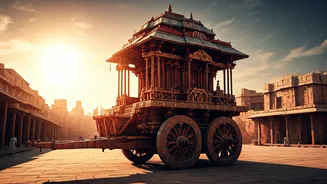
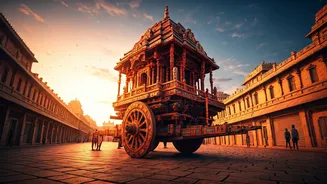
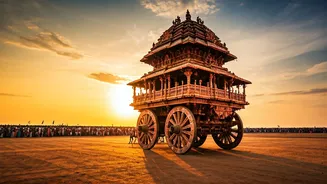
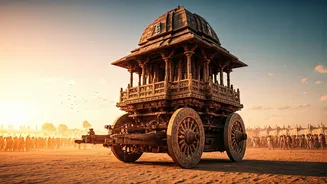
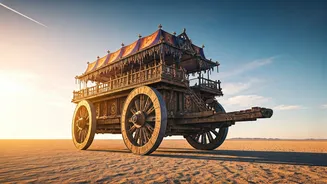
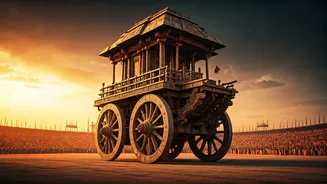
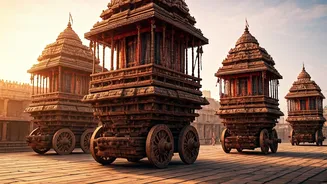
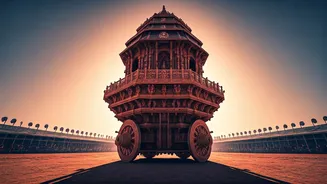
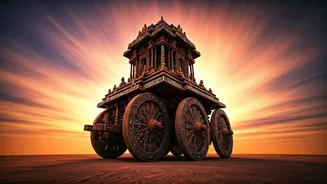
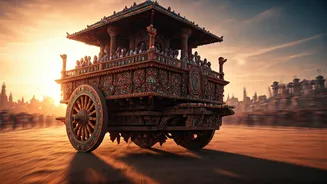
The chariots themselves are marvels of temporary architecture and sacred engineering. Every year, a dedicated team of carpenters builds them anew using wood from specific trees, following strict ancient protocols outlined in religious texts. Each chariot has a name, a specific color scheme, and a set number of wheels. Jagannath’s chariot, Nandighosa, is the largest, standing about 45 feet tall with 16 wheels, draped in red and yellow cloth. The sheer scale of these structures, moved only by human power, creates an unforgettable sight. The festival is steeped in ritual, from the ceremonial procession of the deities from the temple onto the chariots (known as Pahandi) to the symbolic act of the local king sweeping the chariots with a golden broom (Chhera Panhara), demonstrating that everyone is a humble servant before the divine.
From a Local Tradition to a Global Phenomenon
While the Puri Rath Yatra is the original and largest, the festival has transcended its geographical origins. Thanks in large part to the efforts of the International Society for Krishna Consciousness (ISKCON), founded by A.C. Bhaktivedanta Swami Prabhupada, Rath Yatra is now celebrated in over 100 cities around the world, including New York, London, Toronto, and Sydney. In these global celebrations, the core elements remain: processions with smaller-scale chariots, devotional singing (kirtan), and the distribution of sacred food. These events have become a prominent cultural export, introducing the traditions of Odisha to a global audience and providing a vibrant touchstone for the Indian diaspora. They serve as a colorful, public invitation to experience a piece of India’s rich spiritual heritage, effectively placing this once-regional festival on cultural maps far beyond its home state.