






Beyond the Flat Page
Science education has a fundamental challenge: many of its most important concepts are invisible, counterintuitive, or operate on scales too large or small to observe directly. Think about trying to grasp how gravity warps spacetime. A textbook might
show you a 2D image of a bowling ball on a rubber sheet, a useful but deeply limited analogy. The same goes for chemistry, where static ball-and-stick models fail to convey the dynamic, chaotic dance of molecules. This gap between abstract theory and tangible understanding is where many students lose interest or fall behind. We have relied on metaphors and simplified models for centuries, but these tools can only take a learner so far. They don't allow for experimentation or show the consequences of changing a variable, leaving the core principles feeling more like rules to be memorized than phenomena to be understood.
What Is an AI Sandbox?
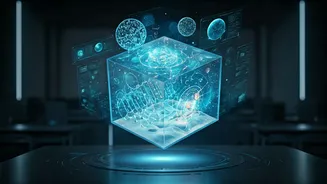
Enter the AI-powered interactive sandbox. Imagine a video game environment, but instead of exploring a fantasy world, you're exploring the laws of physics or the building blocks of life. These are not pre-recorded animations; they are dynamic, 3D simulations. The "sandbox" aspect is key: users aren't passive observers but active participants. They can tweak parameters—like the mass of a star, the temperature of a chemical reaction, or the charge of a particle—and watch in real-time as the system responds. The "AI" is the engine that makes this possible. It manages the immense complexity of the underlying scientific models, calculates the outcomes of user interactions instantly, and renders the results in a visually intuitive way. This turns learning from a one-way lecture into a two-way conversation with the concept itself.
From Quarks to the Cosmos
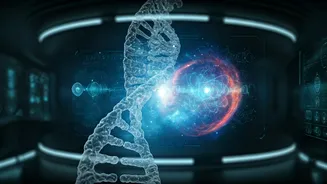
The applications for this technology are as vast as science itself. In physics, a student could fly a virtual spaceship around a black hole, directly observing the effects of gravitational lensing on distant stars. They could change the black hole's mass and see how the 'frame-dragging' effect on spacetime intensifies. In biology, researchers and students can 'step inside' a cell to watch proteins fold. They could grab a strand of amino acids and try to fold it themselves, with the AI providing feedback and showing how different configurations affect the protein's stability and function. This is a game-changer for fields like drug discovery. In chemistry, one could mix virtual elements in a safe environment, manipulating pressures and temperatures to understand reaction kinetics without needing a physical lab. These sandboxes make the invisible visible, allowing for intuition to build alongside intellectual knowledge.
The Technology Powering the Simulation
The magic behind these sandboxes comes from a fusion of several key technologies. At the forefront are powerful graphics processing units (GPUs), the same hardware that powers high-end gaming and cryptocurrency mining. Companies like NVIDIA are heavily invested in using their hardware for scientific simulation, creating platforms that can render these complex worlds. On top of this hardware runs the AI, often a type of machine learning model trained on vast datasets of scientific principles and experimental results. This AI doesn't just animate; it *simulates*. It has learned the rules of the system—be it quantum mechanics or fluid dynamics—and can predict and visualize outcomes that adhere to those rules. This combination of graphical muscle and predictive intelligence is what allows for a responsive, scientifically accurate, and visually compelling experience that was computationally impossible just a decade ago.
A New Era for Discovery
The ultimate promise of AI sandboxes extends far beyond the classroom. They represent a fundamental shift in how scientific research itself might be conducted. Scientists can use these digital laboratories to run millions of virtual experiments, testing hypotheses at a speed and scale that would be physically and financially prohibitive in the real world. A materials scientist could create and stress-test thousands of new alloy combinations to find one with specific properties, or an astrophysicist could simulate different models of galaxy formation to see which one best matches observational data. By democratizing access to complex simulation tools, these sandboxes lower the barrier to entry for experimentation and discovery. They empower not just seasoned researchers but also curious students and citizen scientists to ask "what if?" and get a scientifically grounded answer.