





What Is This ‘Chariot Festival’?
Rath Yatra, which translates to “Chariot Journey,” is one of the most important Hindu festivals, held annually in the coastal city of Puri in the eastern Indian state of Odisha. At its heart, it is a grand procession. Three deities—Lord Jagannath (a form
of Vishnu), his elder brother Balabhadra, and their sister Subhadra—are removed from their home in the main Jagannath Temple and placed on enormous, ornate chariots. Over a million devotees then pull these chariots through the streets for a two-mile journey to the Gundicha Temple, their symbolic summer home, where they will reside for nine days before returning. For many Hindus, it’s a deeply spiritual event, representing the divine coming out from the sanctum to greet the masses, regardless of caste or creed.
The Stars of the Show: The Deities
Unlike the intricate, human-like idols seen in many Hindu temples, the figures of Jagannath, Balabhadra, and Subhadra are distinct and arresting. Carved from sacred wood, they are characterized by their large, round eyes, lack of discernible limbs, and bold, blocky forms. This unique iconography has deep roots in local tribal traditions and a fascinating origin story involving a king, a divine carpenter, and an unfinished creation. Lord Jagannath, meaning “Lord of the Universe,” is identifiable by his black face and large circular eyes. His brother Balabhadra is white, and his sister Subhadra is yellow. During Rath Yatra, these deities leave the rarified air of the temple to travel among the people, an act of immense compassion in the Hindu faith.
Engineering Marvels of Faith
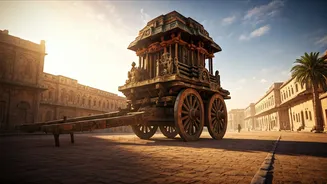
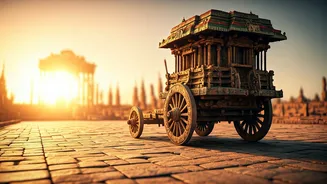
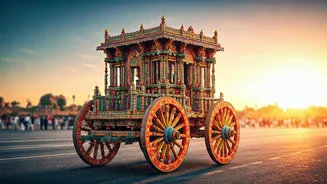
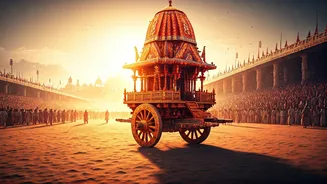
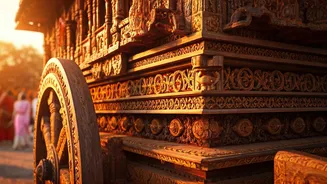
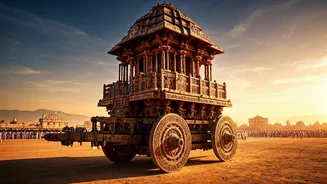
The “magic” of the headline truly comes alive with the chariots. These are not simple floats. They are towering wooden structures, built fresh every year by a dedicated team of carpenters using traditional techniques passed down through generations. Lord Jagannath’s chariot, Nandighosha, stands roughly 45 feet tall and rolls on 16 massive wheels. Balabhadra’s chariot, Taladhwaja, is nearly as large, while Subhadra’s, Darpadalana, is slightly smaller. Each is draped in brightly colored fabrics—red and yellow for Jagannath, red and green for Balabhadra, and red and black for Subhadra. The sheer scale and craftsmanship are a spectacle in themselves, a form of devotional architecture designed to be mobile.
A Sea of Devotion
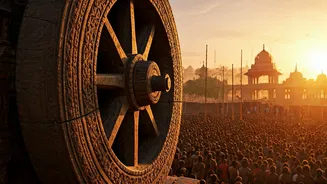
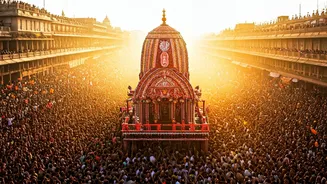
Imagine a parade so large it floods an entire city. That’s the scene on the main day of Rath Yatra. The wide road leading from the temple, known as the Bada Danda, becomes a churning ocean of people. The air is filled with the sounds of cymbals, drums, and chants of “Jai Jagannath!” (Victory to Jagannath). The chariots are pulled not by engines but by human power alone. Devotees surge forward to grasp the thick coir ropes, believing that touching the ropes and helping to pull the divine chariot is an act of immense piety that can wash away sins. It’s a powerful, raw display of collective faith, where the physical effort of millions combines into a single act of worship.
More Than Just a Parade
For an outsider, the spectacle is overwhelming. But for a devotee, Rath Yatra is deeply personal. It’s a festival that breaks down barriers. On this one day, deities who are normally accessible only to priests and practicing Hindus inside the temple are visible to everyone. The symbolic journey also represents the journey of life, with its own struggles (the chariots sometimes get stuck) and ultimate destination. The festival is a complex tapestry of rituals, from the ceremonial sweeping of the chariots by the local king to the offerings made along the route. It’s this combination of jaw-dropping public scale and profound private faith that makes Rath Yatra one of the most compelling human gatherings on the planet.