



A Structure Woven From Nature
Deep in the lush, rain-soaked hills of Meghalaya in northeast India, the local Khasi and Jaintia tribes have perfected a form of natural engineering that seems almost magical. They don't build bridges; they guide them into existence. These living root
bridges, or *jingkieng jri*, are intricate crossings made from the aerial roots of the Indian rubber tree (*Ficus elastica*). Unlike concrete and steel, which rusts and degrades in one of the wettest places on Earth, these bridges are alive. They intertwine with the riverbanks, strengthen with age, and can last for centuries, supporting the weight of dozens of people at a time.
The Art of Patient Gardening
Creating a living root bridge is an exercise in profound patience and generational knowledge. It begins with planting a rubber tree on each side of a river or ravine. As the tree matures, it sends out long, pliable aerial roots. Members of the community then carefully guide these roots across the water, often using hollowed-out bamboo or betel nut trunks as temporary scaffolding. Over 15 to 30 years, the roots slowly grow, thicken, and graft together. The bamboo scaffolding eventually rots away, leaving behind a permanent, self-reinforcing structure. It’s a stunning example of bio-architecture, where human ingenuity works in complete harmony with natural processes, not against them.
Born From the Rain
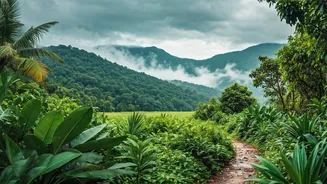
The existence of these bridges is a direct response to the region's extreme climate. Meghalaya, whose name means “abode of the clouds,” is home to some of the rainiest spots on the planet. During the monsoon season, tranquil streams can transform into raging, impassable torrents overnight. Conventional bridges are often no match for the flash floods and relentless moisture. The root bridges, however, are uniquely suited to this environment. The constant dampness prevents the roots from drying out, and the powerful network they form provides a durable, flexible crossing that can withstand the deluge. They are a testament to an indigenous solution perfectly tailored to its surroundings.
The Modern-Day Pilgrimage
For decades, these bridges were simply a practical part of village life, known only to locals. Today, they have become a bucket-list destination for a new kind of traveler—one who seeks authenticity over amenities and wonder over ease. Trekkers from around the world now make the often-strenuous journey into Meghalaya's remote valleys to witness these marvels firsthand. The most famous of them all, the Jingkieng Nongriat, is a spectacular “double-decker” bridge near the village of Nongriat, a breathtaking sight that draws thousands of visitors. This influx of tourism brings both economic opportunity and a critical need for sustainable management, ensuring the bridges and the culture that created them are preserved, not overwhelmed.