








First, What Is the Rath Yatra?
At its heart, the Rath Yatra, or "Chariot Festival," is a grand annual procession celebrating the Hindu deity Lord Jagannath, an incarnation of Vishnu. For centuries, the festival has marked Jagannath's symbolic journey from his home temple in the city
of Puri to his aunt's temple, the Gundicha Temple, about two miles away. He isn’t alone; he is accompanied by his elder brother, Balabhadra, and his sister, Subhadra. Each deity rides in their own immense, custom-built wooden chariot. The festival isn't just a parade; for devotees, it's a deeply spiritual event. The belief is that witnessing the deities on their chariots and, especially, getting to touch the ropes used to pull them, is a profoundly holy act that can wash away sins and bring salvation.
A Spectacle of Unimaginable Scale
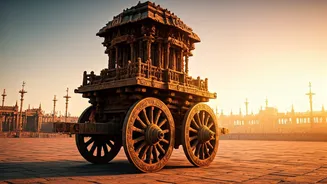
To understand why Puri becomes a 'hotspot,' you have to visualize the scale. This isn’t a local fair. The main procession attracts an estimated one to two million people who flood the city's Grand Road. The chariots themselves are architectural marvels, not parade floats. Lord Jagannath's chariot, Nandighosha, stands roughly 45 feet tall, has 16 wheels, and is draped in vibrant red and yellow cloth. The other two are only slightly smaller. These are not motorized; they are moved entirely by the collective force of thousands of devotees pulling on thick, heavy ropes. The sight of these towering structures inching through a sea of humanity is one of the world's most stunning displays of communal faith and effort, comparable in density and energy to Times Square on New Year's Eve, but amplified by deep religious fervor.
The Spiritual Epicenter of a Nation
For nine days, the entire region revolves around this divine journey. The energy is palpable. Pilgrims travel from every corner of India and across the globe, often enduring long journeys and crowded conditions simply to be present. For them, Puri during Rath Yatra is the spiritual center of the universe. The air is thick with the sounds of gongs, conch shells, and chants of 'Jai Jagannath!' ('Victory to Jagannath'). The festival transcends caste and social barriers, as everyone is invited to participate in pulling the chariots. This egalitarian spirit is central to its appeal, creating a temporary city where the only thing that matters is devotion. This shared purpose turns a diverse crowd into a single, unified force, creating an atmosphere of intense spiritual connection.
An Economic Engine for the Entire State
Beyond its spiritual significance, the Rath Yatra is a massive economic driver for Odisha. Hotels are booked months, sometimes years, in advance. Restaurants, street food vendors, and transportation services operate at maximum capacity. The festival is also a showcase for Odisha's rich artisanal traditions. The chariots are constructed anew each year by families of carpenters who have held this hereditary duty for generations. The colorful fabrics, known as 'pattachitra,' that adorn the chariots and temples are a local art form. Thousands of artisans find employment through the festival, selling religious icons, handicrafts, and textiles to the millions of visitors. For a few weeks, this ancient festival injects a huge amount of cash into the local economy, making it a critical annual event for the region's financial health.
The Modern Logistical Challenge
Managing a temporary city of millions is a monumental task. The state government of Odisha mounts a massive operation each year, deploying thousands of police officers for security and crowd control. Health and sanitation become top priorities, with medical camps and temporary facilities set up along the procession route. In recent years, technology has played a greater role, with CCTV surveillance and live-streamed broadcasts allowing people to participate virtually. Ensuring the safety of the massive crowds while respecting the ancient traditions of the festival is a delicate balancing act. The sheer logistics of hosting the Rath Yatra demonstrate its importance—it’s an event for which an entire state mobilizes its resources, underlining its status as a cultural and social hotspot.