





Why June is the Magic Month
Think of late spring and early summer as your houseplant’s power-up season. After a long winter of shorter days and slower growth, the extended daylight and warmer temperatures of June signal to most plants that it’s time to grow, and grow fast. This
period of active growth is precisely why it's the perfect time to prune. When you trim a plant that’s full of energy, it doesn’t just sit there wounded. Instead, it channels that vigor into healing quickly and pushing out fresh, new foliage, often resulting in a fuller, bushier appearance. Pruning during a dormant period, like deep winter, can stress the plant, as it doesn't have the resources to recover efficiently. By syncing your trimming with the plant’s natural growth spurt, you’re working with its internal clock, not against it.
Identifying Who Needs a Trim
Not every plant in your collection is begging for a haircut, but many will benefit. The best candidates are plants that have become “leggy”—a term for long, sparse stems with leaves spaced far apart. This often happens when a plant is stretching for light. Vining plants like Pothos, Philodendrons, and String of Pearls are prime examples that respond beautifully to a trim, which encourages them to branch out. Likewise, tree-like plants such as the Fiddle Leaf Fig or Rubber Plant can be “topped” (snipping off the top-most growth) to encourage them to grow thicker instead of just taller. Also, be on the lookout for any yellowing, brown, or dead leaves and stems. Removing this unhealthy material allows the plant to redirect its energy toward healthy growth. A quick rule of thumb: if it’s vining, overgrown, or looking a bit sparse, it’s probably a good candidate. Be more cautious with slow-growers like succulents or plants about to flower.
Gather Your Simple Toolkit
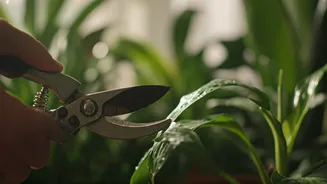
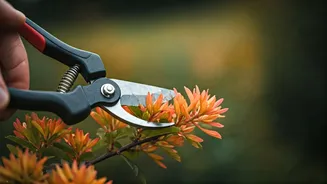
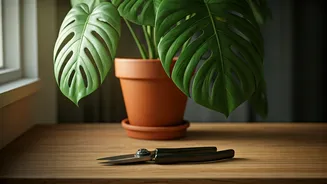
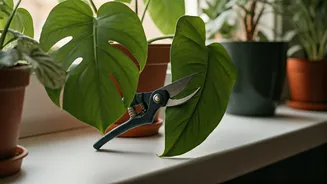
You don't need a professional-grade botanical toolkit to give your plants a healthy trim. In fact, you probably already have what you need. The most important tool is a sharp, clean cutting instrument. For most houseplants with soft stems, a clean, sharp pair of scissors will do just fine. For plants with woodier stems, like a Fiddle Leaf Fig or a small ficus tree, a pair of bypass pruners is a better choice as they make a cleaner cut without crushing the stem. Before you start, the “clean” part is crucial. Wipe your blades with rubbing alcohol or a household disinfectant spray before and between plants. This simple step prevents the spread of any potential diseases from one plant to another, keeping your entire collection safe and healthy. That’s it. Sharp blades, clean blades. You’re ready.
The Art of the Kind Cut
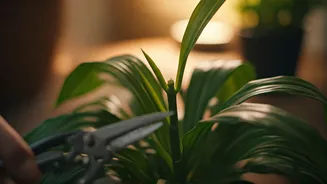
Pruning isn't about wildly hacking away; it's a strategic and surprisingly simple process. First, identify where you want to make your cut. For most vining and branching plants, you’ll want to cut about a quarter-inch above a node. A node is the little bump on the stem where a leaf grows from. This is the site of dormant growth buds, and cutting just above one encourages it to activate and sprout a new stem or leaf. For removing unhealthy leaves, snip them off at the base of their stalk. For shaping, step back and look at your plant. Where is it too dense? Where is it too sparse? Trim to create a more balanced, aesthetically pleasing shape, but never remove more than one-third of the plant’s total mass at one time. And don’t throw away those healthy cuttings from your Pothos or Philodendron! Many can be easily propagated in water to create new plants—a perfect bonus for your efforts.