






A City Within a City
In the heart of India’s sprawling capital lies a world apart. This is Lutyens’ Delhi, the administrative district designed by British architects Edwin Lutyens and Herbert Baker in the early 20th century. It was envisioned as a grand imperial statement,
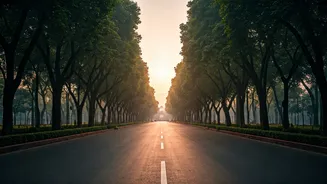
with wide, orderly boulevards radiating from a central axis. But its most enduring legacy isn’t the imposing sandstone government buildings; it’s the trees. The architects, tasked with creating a capital that could withstand the fierce Indian summer, embarked on one of the most ambitious urban forestry projects in history. They planted hundreds of thousands of trees, creating magnificent green corridors that have since matured into majestic, cathedral-like canopies.
Driving Through a Green Tunnel
To experience these routes is to feel the city’s rhythm change. Turn off a traffic-choked artery and onto a street like Amrita Shergil Marg or Prithviraj Road, and the difference is immediate. The noise recedes. The harsh sun is filtered into a dappled, moving mosaic on the pavement. The air feels cooler, scented with blossoms in the spring and damp earth after a monsoon shower. In an auto-rickshaw, the sputtering engine seems to quiet down, no longer competing with a city’s roar. In a car, you instinctively ease off the gas. These aren't just streets for getting from one place to another; they are destinations in themselves. They command a different pace, forcing you to trade urgency for appreciation. This is Delhi’s version of a scenic byway, stitched directly into the urban fabric.
A Symphony of Species
The beauty is not accidental or uniform. The British planners curated the experience with a botanist's precision. Different avenues were given distinct personalities. The roads are lined with towering Arjun trees, their smooth, pale bark almost glowing. Sprawling Banyan trees, with their famous aerial roots, create intricate, shady worlds. In summer, the Gulmohar trees (or Flame of the Forest) erupt in a blaze of scarlet-orange flowers, turning entire streets into fiery spectacles. The Amaltas (or Golden Shower) trees drip with chains of brilliant yellow blossoms. Then there are the Jamun trees, which in monsoon season drop their deep purple fruit, staining the sidewalks below—a nostalgic, messy, and beloved sign of summer for generations of Delhiites. Each route is a living gallery, changing its palette with the seasons.
The Luxury of Slowness
In a megacity where every inch is contested and every second counts, the sheer extravagance of these spaces is what makes them so powerful. The boulevards are defiantly wide, bordered by generous lawns and sidewalks that invite strolling—a true rarity in much of urban India. They offer a psychological release valve. They are where families come for picnics, where diplomats take their morning jogs, and where couples find a moment of quiet intimacy. This experience of slowness is a form of luxury. It’s the ability to move through a city without being assaulted by it, to feel a connection to nature, and to be reminded that even the most dynamic metropolises need places of rest and reflection. These tree routes are not a nostalgic relic; they are a vital, functioning part of what makes Delhi livable.