







The Festival of the Bleeding Goddess
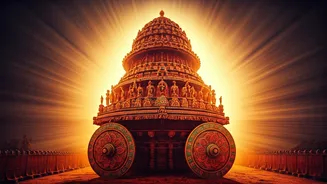
Every year in the eastern Indian state of Assam, hundreds of thousands of pilgrims gather at the Kamakhya Temple for the Ambubachi Mela. Perched atop the Nilachal Hills in Guwahati, this temple is one of the most revered Shakti Peethas, or sacred sites
dedicated to the divine feminine power in Hinduism. But unlike many religious festivals, Ambubachi Mela isn't about celebrating a birth or a victory in battle. It's an annual celebration of menstruation. The festival marks the belief that the presiding goddess, Kamakhya Devi, undergoes her annual menstrual cycle during this time. The temple doors are closed for three days as the goddess is believed to be resting. During this period, farmers halt their work in reverence, patiently waiting for the earth—and the goddess who embodies it—to replenish her creative and fertile power. It's a profound, earthy celebration of fertility, creation, and the cyclical nature of life itself.
Sacred Cycles and Cultural Taboo
The core belief of Ambubachi Mela is powerfully counter-cultural, even within its own context. In many parts of India and the world, menstruation has historically been shrouded in silence and stigma, associated with impurity. Yet, this festival elevates it to the divine. The folklore positions menstruation not as a source of shame but as the very essence of cosmic creative power. When the temple reopens on the fourth day, devotees receive small bits of red-stained cloth, called 'rakta bastra,' believed to be moistened with the goddess's menstrual fluid. This 'prasad' (devotional offering) is considered immensely auspicious, a blessing for fertility and prosperity. This open veneration of a biological process has long made the Ambubachi Mela a focal point for discussions around womanhood, nature, and spirituality. It offers a spiritual framework that sees power and divinity where others have enforced taboo.
From Temple Walls to Digital Canvases
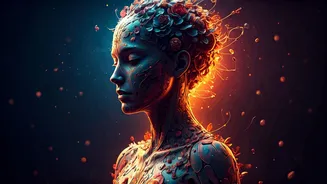
This potent blend of divinity and biology is now fueling a creative explosion online. Young artists from Assam and across India are using digital tools to explore the mythology of Kamakhya. Their illustrations, shared widely on platforms like Instagram and Twitter, are not just devotional but deeply interpretive. Some works depict the goddess in contemplative repose, surrounded by symbols of nature—lotus flowers blooming in blood-red waters, the river Brahmaputra flowing from her. Others are more abstract, using bold colors and graphic styles to evoke the raw energy of creation and destruction. These artists are translating ancient oral and sculptural traditions into a new visual language. They merge traditional Assamese motifs, like the 'gamosa' scarf or 'jaapi' hat, with modern aesthetics, creating art that feels both timeless and urgently contemporary.
A New Generation’s Cultural Statement
The rise of this digital art isn't just about aesthetics; it's a form of cultural reclamation. For a generation fluent in the language of the internet, creating and sharing this art is a way to connect with their heritage on their own terms. It’s a quiet rebellion against the homogenization of culture, a way to put a regional, deeply specific story onto a global stage. Furthermore, by centering their art on a menstruating goddess, these creators are participating in a global conversation about destigmatizing periods. They are using their art to make a feminist statement that is rooted in their own spiritual traditions. It’s a powerful act of saying that the things society might deem 'unclean' or 'private' can, in fact, be divine, beautiful, and worthy of public celebration. This digital reboot of Ambubachi folklore serves as a powerful reminder that tradition is not a static relic but a living, breathing entity that evolves with each new generation of storytellers.