








The Myth of the Magic Number
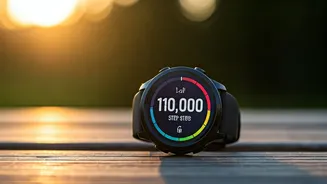
First, let’s get one thing straight: the 10,000-steps-a-day goal was never a medical recommendation. It originated in the 1960s as a marketing slogan for a Japanese pedometer. The name of the device, *Manpo-kei*, translates to “10,000 steps meter.” The number
was catchy, round, and felt substantial, so it stuck. For decades, it has served as a global benchmark, motivating millions to get moving while intimidating millions more who found the target out of reach. While any goal that encourages activity is better than none, we now know that clinging to this arbitrary number misses the real, science-backed story of how walking impacts our health.
Good News: Benefits Start Much Sooner
This is why step counts matter more today: we finally have the data to personalize our goals. Multiple large-scale studies have dismantled the 10,000-step monolith. A 2021 study in *JAMA Network Open* following middle-aged adults found that people who averaged at least 7,000 steps a day had a 50 to 70 percent lower risk of premature death compared to those who walked less. The benefits tended to level off after about 7,500 steps, suggesting you don't need to push for 10k to see huge returns. Another major 2022 study published in *JAMA Internal Medicine* found that while risks for dementia, cancer, and cardiovascular disease continued to decrease up to 10,000 steps, the steepest drop-offs and most significant gains happened much earlier. The takeaway is liberating: every step counts, and you enter the zone of significant health benefits far sooner than you might think.
It's Not Just How Many, But How Fast
The latest science adds another crucial layer: intensity. It turns out that *how* you take your steps can be as important as how many you take. The same 2022 research highlighted the power of a higher step cadence. Participants who walked at a faster pace for even 30 minutes a day (these don’t have to be consecutive) saw a stronger reduction in their risk for dementia, heart disease, and cancer, independent of their total step count. This doesn’t mean you need to break into a sprint on your daily walk. It simply means that incorporating bursts of brisk, purposeful walking—where your heart rate rises and you might find it slightly harder to hold a conversation—can amplify the health rewards. Think of it as an efficiency hack for your health. A 30-minute power walk could be more beneficial than a 60-minute leisurely stroll.
Finding Your Personal Sweet Spot
So, what should your goal be? Instead of fixating on 10,000, start by finding your baseline. Use your phone or a wearable to see how many steps you currently average without trying. From there, aim for a modest increase—adding 500 or 1,000 steps a day is a sustainable and effective strategy. If you are sedentary, aiming for 4,000 steps is a fantastic starting point that already confers measurable benefits. From there, you can gradually work your way toward the 7,000-8,000 range, where many of the biggest gains are found. And don't forget to occasionally pick up the pace. Try turning one of your daily walks into a brisk one, or add a few 10-minute “walking snacks” where you move with purpose. The modern approach to step counting is about progress, not perfection. It’s a flexible tool, not a rigid rule.