

More Than Just Pudding
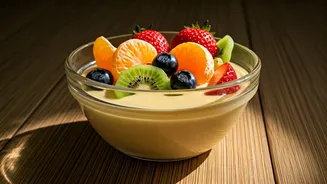
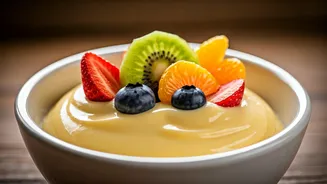
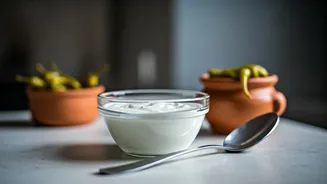
First, let's be clear: this isn't the thick, dense chocolate pudding of American school lunches or the elegant, egg-rich crème anglaise of French pastry. Indian fruit custard is its own glorious category. It’s a light, creamy, and vibrantly colored concoction,
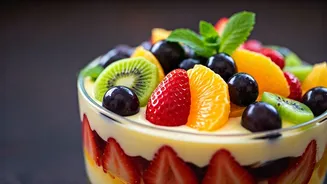
served chilled. The base is a smooth, vanilla-scented custard, but the real magic lies in the explosion of textures and flavors from the fresh fruit suspended within. We’re talking about a sweet, kaleidoscopic mix of chopped apples, soft bananas, juicy grapes, and the jewel-like pop of pomegranate seeds. At its heart is a simple, almost universally known ingredient in Indian households: a bright yellow tin of custard powder.
An Unlikely Colonial Legacy
The story of fruit custard is inseparable from the story of British India. The key ingredient, custard powder, was invented in 1837 by Alfred Bird in Birmingham, England. His wife was allergic to eggs, so he created an egg-free powder using cornstarch, flavorings, and coloring that could mimic traditional custard. The product was a commercial hit and traveled across the British Empire, including to India. Here, it found a uniquely receptive audience. For a country with a large vegetarian population, an eggless custard was a brilliant solution. It was inexpensive, shelf-stable, and incredibly easy to prepare—just mix the powder with sugar and boiling milk. It democratized a classic British dessert, making it accessible to kitchens far from the colonial heart of power.
The Birth of a Party Staple
While custard powder arrived during the colonial era, its reign as the “OG party sweet” began in post-independence India. As a new urban middle class emerged, so did new traditions in hosting. Birthday parties, once modest affairs, became bigger. Potlucks and community gatherings needed dishes that could be made in large quantities, prepared in advance, and please a crowd of all ages. Fruit custard checked every box. It was a forgiving recipe—no complex techniques required. It could be made the day before, freeing up the host. And most importantly, kids and adults loved it. It was seen as modern and sophisticated, a step up from more traditional sweets, yet familiar and comforting. It became the default dessert, the reliable anchor of the potluck table, sitting proudly next to spicy curries and fried snacks.
The Art of the Fruit Mix
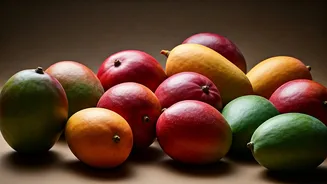
Every family has its own unwritten rules for fruit custard. The foundation is usually a mix of sturdy and soft fruits. Apples provide a crisp crunch, bananas lend a creamy sweetness, and halved grapes offer a burst of juice. Pomegranate arils are non-negotiable for many, adding a ruby-red sparkle and a tart counterpoint. The debates are endless. Should you add mangoes, the king of Indian fruits, knowing they might dominate the flavor? Are citrus fruits like oranges too watery, risking a soggy custard? What about adding a handful of cashews or almonds for texture? In the 90s, some adventurous hosts even layered it with brightly colored cubes of Jell-O to create a dessert known as a “trifle custard,” a further evolution of this endlessly adaptable dish.
Nostalgia in a Bowl
Today, in an era of global culinary trends and picture-perfect Instagram desserts, fruit custard might seem charmingly old-fashioned. You’re less likely to find it on a trendy restaurant menu. But its cultural power hasn't faded; it has simply transformed into nostalgia. For millions of Indian Americans, a bowl of fruit custard is a direct, edible link to their childhood. It’s the taste of a mother’s love, of noisy family gatherings where cousins ran wild, of the simple joy of finding your favorite fruit in your spoonful. It represents a specific time and place—a simpler, less complicated era of celebration. It’s a testament to the idea that the most beloved foods aren't always the most complex, but the ones most deeply tied to our memories of community and happiness.