





So, Why the Sudden Obsession?
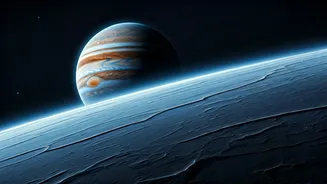
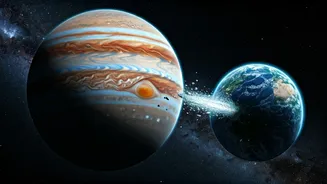
It’s not Jupiter itself that has scientists buzzing; it’s the planet’s incredible gravitational pull. Jupiter is so massive it tugs and squeezes its largest moons as they orbit. This constant flexing, known as 'tidal heating,' generates a tremendous amount
of internal warmth—enough to melt ice and maintain vast, liquid water oceans hidden beneath frozen shells. And where there’s liquid water, energy, and the right chemical ingredients, there’s a chance for life. This realization has turned Jupiter's moons from cold, dead rocks into the most compelling astrobiological targets in our solar system. Two of the most ambitious science missions ever conceived—NASA’s Europa Clipper and the European Space Agency's JUICE—are currently en route or in final preparations, specifically to investigate these potential ocean worlds. This is no longer science fiction; it’s a multi-billion-dollar, international scientific priority.
The Headliner: Europa
If Jupiter’s moons were a band, Europa would be the lead singer. It’s a world slightly smaller than our own moon, but it’s covered in a shell of water ice that’s thought to be miles thick. The real story lies beneath. Data from previous flybys strongly suggest a colossal, globe-spanning ocean of liquid saltwater that may contain more than twice the amount of water in all of Earth's oceans combined. This isn't just a puddle; it's a dark, dynamic sea warmed by tidal forces and potentially hosting hydrothermal vents on its seafloor. On Earth, such vents are teeming with life that thrives without sunlight. The possibility that a similar ecosystem exists on Europa is the driving force behind NASA's flagship Europa Clipper mission, set to launch in late 2024. The spacecraft won’t land, but it will perform dozens of close flybys, using a suite of powerful instruments to taste and smell plumes of water vapor that may be erupting from the ocean through cracks in the ice, effectively sampling the ocean from space.
The Overlooked Giant: Ganymede
Often living in Europa’s shadow, Ganymede is the quiet, mysterious giant of the group. It’s the largest moon in the entire solar system—bigger than the planet Mercury—and the only one known to have its own magnetic field. For a long time, scientists thought its interior was frozen solid. But newer models and data from the Galileo probe suggest Ganymede also has a subsurface ocean, perhaps an even larger one than Europa's. The catch? Ganymede's ocean might be a 'club sandwich' of sorts, trapped between layers of different types of ice, which could make it harder for chemicals from the rocky seafloor to mix into the water. The European Space Agency's JUICE (JUpiter ICy moons Explorer) mission, which launched in 2023, is making Ganymede its primary target. After performing flybys of Europa and Callisto, JUICE will become the first spacecraft to ever orbit a moon other than our own, settling in around Ganymede in the 2030s to map its ocean and magnetic field in unprecedented detail.
The Volcanic Wildcard: Io
While Europa and Ganymede get attention for their potential oceans, their sibling Io is a world of pure chaos—and it’s just as important for understanding how these systems work. Io is the most volcanically active body in the solar system, with hundreds of volcanoes spewing sulfurous plumes hundreds of miles into space. This hellish landscape is a direct result of Jupiter’s extreme tidal forces, which churn Io’s interior into a molten mess. While it’s not a candidate for water-based life, Io is a perfect natural laboratory. By studying it, scientists can better understand the physics of tidal heating—the very engine that makes the oceans of Europa and Ganymede possible. It provides a crucial piece of the puzzle, showing what happens when gravitational squeezing is pushed to its absolute limit. Probes like Juno, while focused on Jupiter, have given us stunning new images of Io’s violent surface, reminding us that the Jovian system is as much about fire as it is about ice.