




The Invisible Shooting Gallery
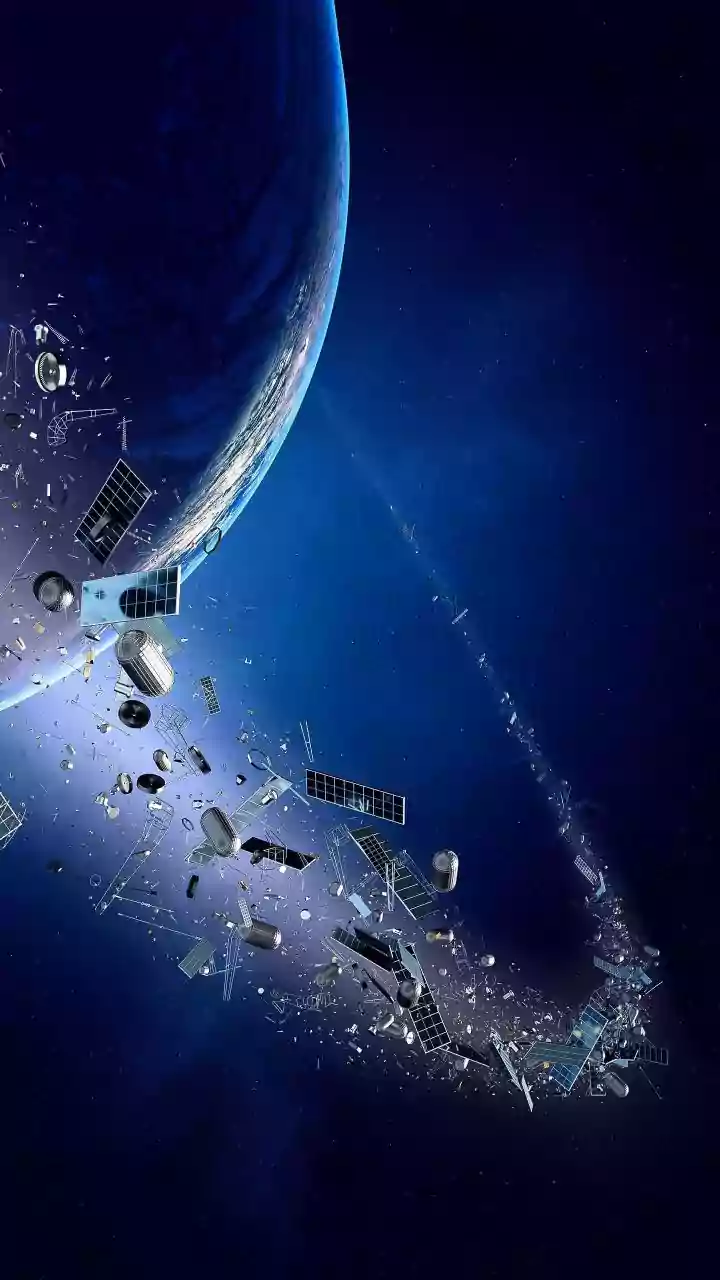
When we look up at the night sky, we see a vast, empty peace. But the region just above our atmosphere, known as Low Earth Orbit (LEO), is anything but peaceful. It’s a cosmic shooting gallery, filled with millions of tiny projectiles traveling at mind-boggling
speeds. These aren't just natural space dust; they're a chaotic mix of micrometeoroids—minuscule specks of rock from comets and asteroids—and man-made orbital debris. This human-generated junk includes everything from flecks of paint that have chipped off old rockets to slag from solid rocket motors, and even frozen droplets of coolant. From a satellite's perspective, it doesn't matter if it’s hit by a natural meteoroid or a piece of man-made trash. The result is the same: a high-energy impact that can disable, destroy, or endanger.
It’s Not the Size, It’s the Speed
The real danger isn’t the size of these particles, but their incredible velocity. Objects in LEO travel at around 17,500 miles per hour. When two objects moving in different orbital paths collide, their relative impact speed can be even higher, exceeding 22,000 miles per hour. At these speeds, a concept called hypervelocity comes into play. The kinetic energy of an object is determined by its mass and the square of its velocity. This means that speed is a far more significant factor than size. A paint chip the size of a flake of pepper, weighing almost nothing, carries the destructive energy of a bowling ball moving at 60 mph on impact. A marble-sized object has the explosive power of a hand grenade. This is why NASA and other space agencies don't just worry about the big, trackable pieces of space junk; they are just as concerned with the millions of tiny 'bullets' that are too small to see but powerful enough to end a mission.
A History Written in Dents
The evidence of this constant barrage is written all over the hardware we've brought back from space. For decades, Space Shuttle missions provided a unique opportunity to study the effects of these impacts. The shuttles’ windows, made of incredibly tough fused silica and aluminosilicate glass, often returned to Earth with tiny pits and craters. One famous impact on the shuttle Challenger in 1983 left a nearly quarter-inch-wide crater from a particle estimated to be just a few thousandths of an inch across. The International Space Station (ISS) is a living testament to this threat. Its surfaces are continuously sandblasted by micrometeoroids and orbital debris (MMOD). In 2016, a 7mm crater was discovered in one of the station’s thick Cupola windows, likely caused by an object just fractions of a millimeter in size. Astronauts on spacewalks have reported seeing shimmering, almost beautiful impacts as tiny particles vaporize against the station's hull in a flash of light.
Building an Orbital Body Armor
So how do we protect billion-dollar satellites and priceless human lives from this threat? You can't just wrap a spacecraft in thick steel; the weight would make it impossible to launch. The solution, developed in the 1940s by astronomer Fred Whipple, is brilliantly counterintuitive. The Whipple Shield doesn't try to stop the projectile outright. Instead, it consists of a thin outer layer—the sacrificial bumper—placed a few inches away from the main wall of the spacecraft. When a hypervelocity particle hits this outer layer, it vaporizes both itself and a small piece of the shield into a cloud of smaller, slower particles. This plume then spreads out, distributing its energy over a much larger area of the spacecraft's main wall, which can easily absorb the now-diffused impact. It’s like using a paper-thin screen to turn a single deadly bullet into a harmless spray of mist. For larger, trackable debris (the size of a softball or bigger), the strategy is avoidance. A global network of radars, including the U.S. Space Surveillance Network, tracks tens of thousands of objects, allowing satellite operators and the ISS to perform carefully planned maneuvers to dodge a potential collision.