








A New Light in the Cosmic Dawn
In the vast, dark expanse of the early universe, something was shining with unimaginable intensity. Using data from state-of-the-art telescopes like the James Webb Space Telescope (JWST), a team including astronomers from MIT has pinpointed one of the most
extreme objects ever observed: a quasar so old its light has been traveling toward us for over 12 billion years. We are seeing it as it was when the universe was just a toddler, less than two billion years old. This object, officially known as J0529-4351, isn’t just old; it’s the most luminous object ever detected from this era, outshining our entire Milky Way galaxy by a factor of hundreds. Finding it was like spotting a single, blindingly bright searchlight across a continent-sized, pitch-black stadium.
So, What's a Quasar Anyway?
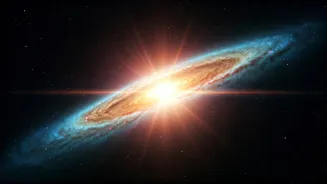
Before we go further, let's break down what a quasar actually is. The name is short for "quasi-stellar radio source," because when they were first discovered, they just looked like faint, star-like points of light. The reality is far more spectacular. At the heart of a distant, young galaxy sits a supermassive black hole, millions or even billions of times the mass of our sun. This gravitational monster is on a cosmic binge, pulling in a massive, swirling disk of gas, dust, and stars. As this material gets closer to the black hole, it heats up to incredible temperatures from friction and compression, causing it to glow with an intensity that can outshine all the stars in its host galaxy combined. A quasar, then, isn't the black hole itself, but the brilliant light show produced by its insatiable appetite.
The 'Flicker' That Tells a Story
The headline’s mention of “flickering” isn’t like a faulty lightbulb. In astronomy, this refers to the quasar’s variability—its brightness changes over time. This isn’t a bug; it’s a feature that provides a wealth of information. The fluctuations in light from J0529-4351 tell scientists about the chaos happening around the black hole. By analyzing these changes, they can estimate just how much material the black hole is consuming. The results are staggering: this particular black hole is swallowing the equivalent of one sun’s mass every single day. This ferocious feeding frenzy is what powers its extreme brightness, and the 'flicker' is the signature of this violent, high-speed cosmic meal. It’s the celestial equivalent of watching the wild, sputtering flame of a jet engine close up.
A Window to a Cosmic Mystery
Finding a quasar this bright and this ancient is more than just a record-breaking discovery; it helps astronomers tackle a major cosmic chicken-and-egg problem. For years, scientists have been puzzled by how supermassive black holes grew to such enormous sizes so quickly after the Big Bang. Standard models suggested a slower, more gradual growth. An object like J0529-4351, already a behemoth in the universe's infancy, challenges those models. It suggests that the conditions in the early universe may have allowed for 'hyper-growth' phases, where black holes could pack on mass at an astonishing rate. This quasar serves as a perfect, real-world laboratory for testing new theories about galaxy formation and the evolution of the cosmic giants that lurk at their centers.