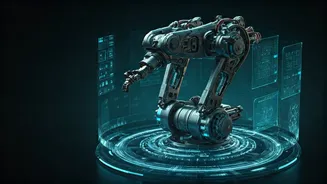









Beyond CAD: What Is an AI Sandbox?
Forget the static, 2D blueprints of the past, or even the familiar 3D models of modern Computer-Aided Design (CAD). An engineering AI sandbox is a different beast entirely. Think of it less as a drawing board and more as a powerful video game engine,
but one that obeys the strict laws of real-world physics. It’s a collaborative, virtual environment where engineers, designers, and AI can meet to interact with a machine that doesn't exist yet. This 'sandbox' is infused with artificial intelligence that understands material properties, stress, thermodynamics, and fluid dynamics. Instead of just drawing a shape, you're placing a virtual object with realistic mass, strength, and behavior into a simulated environment. You can turn it on, push it to its limits, and see how it reacts, all before a single piece of metal is ever cut.
The 'Digital Twin' Comes Alive
The core concept powering these sandboxes is the 'digital twin.' This isn't just a 3D model; it's a comprehensive, data-rich virtual replica of a physical object, system, or even an entire factory. A CAD model shows you what a jet engine looks like. A digital twin of that engine, living in an AI sandbox, simulates how it operates. It mirrors the performance, temperature, and wear-and-tear of its real-world counterpart. The sandbox is the habitat where this twin lives and breathes. Engineers can feed it real-time data from sensors on a physical prototype, allowing the digital version to evolve and reflect reality with astonishing accuracy. More importantly, they can run countless 'what-if' scenarios. What happens if we increase the turbine speed by 15%? What if a foreign object gets sucked in? These are questions that are incredibly expensive, dangerous, or impossible to test in the real world, but can be run a thousand times a day inside the sandbox.
From Blueprint to Intelligent Creation
The most revolutionary aspect is that engineers are no longer the only ones doing the building. This is where AI becomes a creative partner. Using a process called 'generative design,' an engineer can define a problem instead of a solution. For example, they might tell the AI, 'I need a robotic arm bracket that can support this weight, fit in this exact space, and is as lightweight as possible using aluminum.' The AI then goes to work, iterating through thousands, or even millions, of potential designs in minutes. It might produce organic, alien-looking shapes that a human designer would never conceive of, but which are perfectly optimized for the task. The engineer is no longer just a draftsman but a conductor, setting the goals and constraints, and letting the AI explore the vast landscape of possible solutions to find the most efficient one.
The Real-World Payoff
This technology isn't a distant sci-fi fantasy; it’s already reshaping industries. Automotive companies are using AI sandboxes to simulate entire vehicles, testing crash physics and aerodynamics digitally, drastically cutting down the time and expense of building and destroying physical prototypes. Aerospace firms are modeling complex airflow over a new wing design to maximize fuel efficiency. Factory planners are creating digital twins of their assembly lines to identify bottlenecks and optimize robot movements before installing a single piece of equipment. The payoff is immense: dramatically accelerated research and development, less material waste, safer products, and the ability to design systems of a complexity that was previously unmanageable. It represents a fundamental shift from slow, linear design to rapid, parallel innovation.
![[WATCH] Tri-Nation Series 2026: Vaibhav Sooryavanshi pulls off sensational rebound catch in India A's win over Afghanistan A](https://g-mob.glance-cdn.com/public/fc/image/uLhEHvbinF-0.webp)