




The Carbon Footprint on Your Plate
For years, the nutrition label has been our primary guide to food choices. Calories, fat, sodium—we know the drill. But a new, invisible metric is starting to demand our attention: the carbon footprint. Put simply, every food item has an environmental
cost associated with its production, from farm to fork. This includes the energy used, the land cleared, the water consumed, and, crucially, the greenhouse gases emitted. The global food system is responsible for about a third of all human-caused emissions, and not all foods are created equal. The undisputed heavyweight champion of climate impact is red meat, particularly beef and lamb. Ruminant animals like cows produce methane, a potent greenhouse gas, as part of their digestion. They also require vast amounts of land for grazing and feed cultivation, often leading to deforestation. Studies have consistently shown that producing a kilogram of beef emits many times more greenhouse gases than producing a kilogram of chicken, and exponentially more than plant-based proteins like lentils or tofu.
From Menus to Grocery Aisles
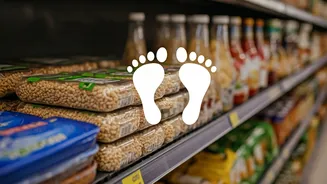
This climate reality check isn't just an academic exercise; it's showing up where we make our decisions. Forward-thinking restaurant chains have started adding carbon labels to their menus right next to the calorie counts. Much like seeing that a double cheeseburger has 800 calories can make you reconsider, seeing that it has the carbon footprint equivalent of a 10-mile drive in a gas-powered car might do the same. Companies like Panera Bread and Just Salad have been pioneers in this space, providing customers with information to make climate-conscious choices. This transparency is slowly bleeding into grocery stores, too. Brands are beginning to market their products' low environmental impact, and you might see certifications or labels from third-party organizations like the Carbon Trust. This is the 'nutrition label' for the 21st century, shifting the definition of a 'good' food choice from being solely about personal health to also including planetary health. It’s a powerful nudge that reframes consumption as an environmental act.
It's More Than Just Meat
While beef gets most of the headlines, the climate calculus of food is more nuanced than a simple 'plants good, meat bad' binary. Other factors play a significant role. Consider 'food miles'—the distance your food travels. Avocados shipped from Mexico or asparagus flown in from Peru during the winter have a higher transport-related footprint than locally sourced produce. However, this can be complicated; sometimes, it's more efficient to grow tomatoes in a sunny climate and ship them than to grow them in an energy-intensive greenhouse locally. Dairy products, particularly cheese, also have a surprisingly high carbon footprint due to the emissions from dairy cows. Even certain plant-based foods aren't off the hook. Almond milk, for instance, requires enormous amounts of water in drought-prone regions like California. The point isn't to find a 'perfect' food, which doesn't exist, but to understand that our choices exist on a spectrum of environmental impact.
The Elephant in the Room: Food Waste
Perhaps the most sobering part of the food-climate equation has nothing to do with what we choose to eat, but what we choose to throw away. In the United States, an estimated 30-40% of the food supply is wasted. This isn't just a moral or economic failure; it's a massive climate catastrophe. When food ends up in a landfill, it decomposes and releases methane, that same potent gas produced by cows. All the resources—the water, the land, the energy, the labor—that went into producing that food are wasted, and then it actively harms the planet as it rots. If global food waste were a country, it would be the third-largest greenhouse gas emitter after China and the U.S. This puts individual responsibility in perspective. While choosing lentils over lamb is a positive step, ensuring the food you buy actually gets eaten is one of the most impactful climate actions a person can take in their own kitchen.