







The Man Behind the Rake
The artist behind many of these viral creations is Jean-Benoit Pourrié, known professionally as Jben. Operating primarily on the beaches of his native France, particularly in the Royan area, Jben has turned the shoreline into his personal gallery. Using
simple tools—a rake, a stick, and occasionally a rope for creating perfect circles—he crafts geometric mandalas, whimsical characters, and massive, intricate frescoes on the sand. His work isn't just art; it's a performance. It requires him to be a surveyor, an athlete, and a philosopher, all while racing against nature's clock. What starts as a sketch on paper or a digital design on his computer is meticulously transferred onto the sand, often with the help of a drone to maintain perspective on the enormous scale of his projects.
A Race Against the Tide
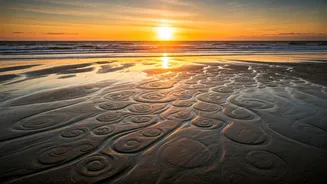
The creation of each piece is a masterclass in planning and execution under pressure. Jben’s work can only happen during a narrow window of opportunity: the few hours of low tide. The wet, compacted sand provides the perfect canvas, dark enough to create contrast when the top layer is raked away, revealing the lighter sand beneath. The process is intensely physical. He walks miles back and forth, dragging his rake with precision to carve out the clean, flowing lines that define his style. Some of his largest works can span over 30,000 square feet. It's a solitary, meditative process, a dialogue between the artist and the ocean. He isn't fighting the tide; he’s collaborating with it, using the time it grants him to create something beautiful before it returns to claim the beach once more.
Art Designed to Disappear
To the outside observer, the central question is obvious: Why pour so much effort into something that will be washed away in a few hours? For Jben and other ephemeral artists, that’s precisely the point. The temporary nature of the art is its most powerful statement. In a world obsessed with permanence, archives, and legacies, his work is a celebration of the present moment. It’s an exercise in letting go. The value isn't in possessing the final product, but in the act of creation and the fleeting experience of witnessing it. The art exists in its own perfect, temporary state, a reminder that beauty doesn't need to last forever to be profound. Viewers who stumble upon it on the beach get to experience a unique, unrepeatable moment before the waves smooth the canvas clean, leaving no trace behind.
From French Beaches to Global Screens
Here lies the modern paradox of Jben’s work. While the physical art is gone in a matter of hours, it has found a second, permanent life online. Through stunning drone footage and photography shared on social media platforms like Instagram and YouTube, his temporary creations have become enduring viral sensations. Millions of people who will never set foot on a French beach have been mesmerized by his sand frescoes. This digital permanence creates a fascinating contrast with the art's physical impermanence. The viral spread has turned a local, transient art form into a global phenomenon, allowing the message of living in the moment to be shared and appreciated indefinitely. It proves that even in our hyper-documented age, there is a deep and universal appreciation for the beautiful and the temporary.