



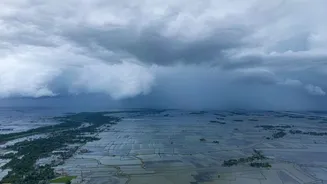


A Deceptive, Dazzling Beauty
Imagine a sunset so vibrant it seems to set the sea on fire, painting the clouds in shades of deep orange, violet, and pink. This is a common sight along the Bay of Bengal, especially during the volatile pre- and post-monsoon seasons. Before a major weather
system forms, the atmosphere can grow uncannily still. The air becomes thick and humid, and the sky, cleared by shifting high-altitude winds, offers a canvas for unusually dramatic light. It’s a photographer’s dream and a source of local awe. But this period of stunning atmospheric optics is often a harbinger. The same conditions that create the beautiful skies—warm, moist air and shifting wind patterns—are also the building blocks for one of nature’s most destructive forces: the tropical cyclone.
The High Cost of Waiting
The “risky-delays” mode is where beauty gives way to a tense, calculated reality. As soon as India’s Meteorological Department (IMD) issues a cyclone alert for the Bay of Bengal, a well-rehearsed and life-critical chain of events begins. Fishing, the economic lifeblood for countless coastal communities, comes to a dead stop. Government orders send thousands of fishing trawlers and small boats scrambling back to already crowded harbors. The financial loss is immediate; every day spent ashore is a day without income. Major ports like Visakhapatnam and Krishnapatnam, crucial hubs for national and international trade, go on high alert. Cargo operations slow down, ships are ordered to anchor in safer waters, and schedules for everything from steel exports to agricultural goods are thrown into chaos. For ordinary citizens, it means preparing for evacuations, stocking up on essentials, and facing the anxiety of a potential disaster.
Why the Bay of Bengal is a Cyclone Hotspot
The Andhra Pradesh coast lies in a particularly hazardous neighborhood. The Bay of Bengal is a notoriously effective incubator for cyclones. Its warm, shallow waters act like a bathtub, providing the thermal energy these storms need to form and intensify rapidly. Unlike an open ocean, the bay is semi-enclosed, and its funnel shape to the north can dramatically amplify storm surges, pushing massive walls of water inland. For American readers, a cyclone is essentially the same phenomenon as a hurricane in the Atlantic or a typhoon in the Pacific. The cyclones that form here are among the deadliest in history, and while forecasting has improved dramatically, the sheer density of the population along the coast makes every storm a major potential catastrophe. Climate change is only amplifying the risk, with scientists noting an increase in the intensity and frequency of severe storms in the region.
A Seasonal Rhythm of Risk and Resilience
While the threat is severe, this is not a story of helpless victims. Living with this cycle of beauty and danger has forged a profound resilience in the people of Andhra Pradesh. Decades of experience with cyclones have led to one of the world's most sophisticated early warning and disaster management systems. The IMD’s color-coded warnings are broadcast relentlessly via radio, television, and now, text messages. A vast network of cyclone shelters provides refuge for those in low-lying areas. Community-level disaster response teams drill for evacuations. This seasonal rhythm is deeply embedded in the culture. The knowledge of when to respect the sea, when to retreat from the coast, and how to rebuild has been passed down through generations. It's a testament to human adaptation in the face of overwhelming natural power.