







More Than Just a Long Road Trip
Getting to Mars is, without a doubt, an immense logistical puzzle. The journey spans over 140 million miles at its closest approach, requiring a flight of seven to nine months each way. Engineers have to design spacecraft capable of sustaining a small
crew for years, carrying enough food, water, and breathable air while recycling every possible resource. They must master a pinpoint landing on a planet with a thin atmosphere, a feat so difficult it’s nicknamed the “seven minutes of terror.” These are monumental engineering challenges, but in many ways, they are known quantities. We know how to build powerful rockets and sophisticated life-support systems. We have landed robotic rovers successfully. While incredibly difficult, these are problems that fall within the realm of conventional physics and engineering. The solutions, however expensive and complex, are conceptually straightforward. But another challenge operates on a different level entirely, one that we cannot simply engineer our way around.
The Invisible, Relentless Enemy
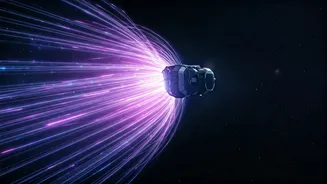
The single biggest challenge of reaching Mars is radiation. Once a spacecraft leaves the protective bubble of Earth’s magnetic field, it is bombarded by a constant storm of high-energy particles. This isn't like the radiation we encounter on Earth; it's a combination of two potent threats. The first is Galactic Cosmic Rays (GCRs), the remnants of distant supernovae that travel at nearly the speed of light. Think of them as microscopic cannonballs that can tear through metal and human tissue. The second threat is Solar Particle Events (SPEs), unpredictable bursts of energy from our own sun that can deliver a massive dose of radiation in a short period. While astronauts on the International Space Station are still largely protected by the Earth’s magnetosphere, a crew on a Mars mission would be fully exposed for the entire multi-year trip. NASA has identified this as one of the most critical risks, a fundamental barrier that makes deep space fundamentally hostile to human life.
A Threat to Body and Mind
The effects of this deep-space radiation are insidious and profound. Over the course of a mission, the cumulative exposure dramatically increases an astronaut's lifetime risk of developing cancer. But the more immediate concern is damage to the central nervous system. Studies on animals exposed to GCR-like radiation have shown significant cognitive decline, memory loss, and reduced decision-making ability. In essence, the very radiation they’re flying through could impair an astronaut’s ability to perform complex tasks, handle emergencies, or even remember their training—a catastrophic risk for a mission where every action is critical. Beyond the long-term cancer and cognitive risks, a sudden, powerful SPE could cause acute radiation sickness, leading to nausea, fatigue, and immune system failure. Protecting the crew’s health isn't just about their future well-being; it's about ensuring they are functional enough to keep the mission—and themselves—alive.
The Crushing Weight of a Solution
So, why can’t we just shield the spacecraft? The problem is mass. On Earth, we are protected by our thick atmosphere and a powerful magnetic field. Replicating that protection in space would require an immense amount of shielding. The most effective materials for blocking GCRs, like water or hydrogen-rich polymers, are incredibly heavy. A thick shield of lead or aluminum would add an impossible amount of weight to the spacecraft. Every extra pound launched into space costs thousands of dollars and requires more fuel, creating a vicious cycle. Adding enough shielding to adequately protect a crew for a three-year round trip could make the spacecraft too heavy to launch with current rocket technology. Scientists are exploring alternative solutions, from creating localized magnetic fields around the ship to developing new pharmaceuticals that could help repair radiation-induced cell damage. But as of now, there is no silver bullet. The radiation problem remains the fundamental constraint that dictates the design, duration, and ultimate feasibility of any human mission to Mars.