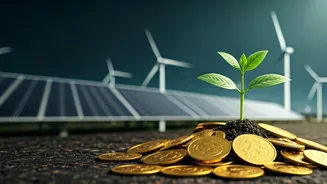









More Than Just a Trend
Walk onto any college campus or scroll through financial advice forums on Reddit, and you’ll find a conversation that barely existed a decade ago: values-based investing. For Millennials and Gen Z, the idea of aligning their financial portfolio with their personal
ethics isn't a niche strategy—it’s becoming the default. And at the heart of this movement are green energy mutual funds, which have emerged as one of the most compelling destinations for their investment dollars. While calling it the single 'top choice' might be an oversimplification in a diverse market, the data shows an undeniable and powerful pull. Surveys consistently find that younger investors are significantly more likely than their parents or grandparents to prioritize Environmental, Social, and Governance (ESG) factors when making investment decisions. Green energy funds are the most direct and tangible way to act on that conviction.
What Exactly Are These Funds?
For the uninitiated, a mutual fund is essentially a professionally managed portfolio that pools money from many investors to purchase a collection of stocks, bonds, or other assets. A green energy mutual fund, then, is a specialized version of this. It focuses specifically on companies operating in the renewable energy sector. Think of businesses involved in solar panel manufacturing, wind turbine development, electric vehicle (EV) technology, battery storage solutions, and smart grid infrastructure. By buying into one of these funds, an investor gains exposure to dozens of companies in the clean energy ecosystem without having to research and purchase each individual stock. This diversification helps mitigate the risk of any single company failing, while still allowing investors to bet on the growth of the sector as a whole.
It’s About Profit, Not Just Principle
It’s a common mistake to assume this trend is purely about altruism. For many young investors, backing green energy is a pragmatic, long-term financial calculation. They’ve grown up seeing the escalating effects of climate change and the global political will shifting—however slowly—toward a low-carbon future. They see the transition away from fossil fuels not just as an environmental necessity, but as one of the biggest economic transformations of their lifetime. In their eyes, investing in a solar company today is like investing in an automobile company in the early 20th century or a tech company in the 1990s. They believe they are getting in on the ground floor of a massive, multi-decade growth story. This perspective frames green investing not as a sacrifice of returns for morals, but as a strategy to capture future growth that older, more traditional portfolios might miss.
The Risks of Going Green
Of course, no investment is without risk, and the green energy sector has its own unique set of challenges. One of the biggest concerns is 'greenwashing,' where companies exaggerate their environmental credentials to attract ESG-minded investors. It takes diligence from fund managers to weed out the pretenders. Furthermore, the sector can be highly sensitive to government policy. Subsidies, tax credits, and regulations can make or break a company's profitability, leading to volatility when political winds shift. These funds are also, by definition, less diversified than a broad market index fund like an S&P 500 tracker. If the entire clean energy sector hits a rough patch, the fund's value will likely fall more sharply than the market at large. For young investors with a long time horizon, this volatility can be an acceptable trade-off for higher growth potential, but it's a risk that shouldn't be ignored.