







The Two Faces of the Monsoon
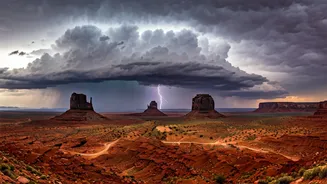
For residents and visitors in the American Southwest, the summer monsoon is a season of profound contradictions. From roughly mid-June to late September, a dramatic shift in wind patterns pulls moisture up from the Pacific Ocean and the Gulf of Mexico,
breaking the region’s notorious dry heat with spectacular thunderstorms. This is the season that brings the desert to life. Cacti bloom, rivers swell, and the landscape is painted with some of the most breathtaking sunsets on Earth. It’s no wonder people plan vacations, photography trips, and epic hikes to coincide with it. But this beauty has a brutal flip side. The same storms that offer relief and stunning visuals are also responsible for the region’s most dangerous weather phenomena: flash floods, lightning, and powerful dust storms (haboobs). The frustration of a canceled plan is real, but the danger behind that National Weather Service alert is even more so. The core problem is that our intuition, honed in more temperate climates, is dangerously wrong in the desert.
Why the Desert Doesn't Drink Water
Here’s the part that gets people killed: a dry desert landscape does not behave like a Midwestern field or an East Coast forest. After months of being baked under an intense sun, the ground becomes hard and non-porous, a condition known as hydrophobic soil. It repels water rather than absorbs it. Think of it less like a sponge and more like a concrete parking lot.
When a monsoon storm unleashes a massive amount of rain in a short period, the water has nowhere to go. It immediately runs downhill, gathering speed, power, and debris. This is how a picturesque dry wash or a narrow slot canyon can transform into a violent, churning torrent of water, rocks, and mud in mere minutes. The most terrifying part? The storm that triggers the flood could be miles away, completely out of your sight and hearing. You could be standing under a perfectly sunny sky and have no idea that a ten-foot wall of water is roaring toward you.
Decoding the Alerts You Can't Ignore
When your phone screams at you, it’s using a specific language. Understanding it is key to survival.
Flash Flood Watch: This is the “heads up.” It means conditions are right for flash flooding. The ingredients are in the kitchen, but the dangerous meal isn't cooking yet. This is your cue to reconsider plans that involve low-lying areas, canyons, or washes. Have an escape route in mind and stay informed.
Flash Flood Warning: This is the “get out now” alarm. A flash flood is either already happening or is imminent, confirmed by radar or a spotter on the ground. This isn’t a suggestion; it’s an order. Your only job is to get to higher ground immediately. A warning means the threat to life and property is active and real.
Ignoring the difference between a “watch” and a “warning” is a common and fatal mistake.
Avoiding the Classic Danger Zones
Those “pretty plans” often lead people directly into danger. Slot canyons, for example, are a hiker’s dream and a rescuer’s nightmare. Their narrow, sculpted walls are gorgeous, but they also act as natural funnels, concentrating floodwaters with no chance of escape. A warning for a storm ten miles upstream should be treated as a direct threat to the canyon you're in.
Then there’s the roads. Every year, people die attempting to drive through flooded washes. The saying “Turn Around, Don’t Drown” isn't just a catchy slogan; it's a plea based on grim reality. It takes only six inches of moving water to knock an adult off their feet, and just twelve inches to sweep away a small car. You can’t tell how deep the water is or if the road underneath has been washed away. The risk is never, ever worth it.
Finally, don't forget the lightning. In a wide-open landscape, you are the tallest object for miles. The old rule of “if you can hear thunder, you can be struck by lightning” is absolutely true. Seeking shelter in a building or a hard-topped vehicle is the only safe move.