









The Policy 'Big Bang'
Until very recently, space in India was a one-company town. The Indian Space Research Organisation (ISRO), the nation's vaunted government agency, did everything from building satellites to launching rockets. It was successful, famously sending a mission
to Mars for less than the production budget of the movie 'Gravity.' But the private sector was largely relegated to being component suppliers. That all changed in 2020. In a move experts call a 'Big Bang' reform, the Indian government threw the doors open. It created a new regulatory body, IN-SPACe, specifically to nurture and authorize private space companies. Suddenly, startups weren't just allowed to build parts; they were encouraged to build, own, and operate their own rockets, satellites, and ground stations. This policy shift effectively lit the fuse for a commercial space explosion.
The New Kids on the Launchpad
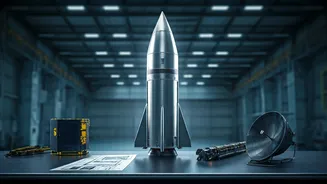
The result has been the rapid emergence of over 150 registered space startups, attracting hundreds of millions in venture capital. Two companies in particular, Skyroot Aerospace and Agnikul Cosmos, have become the poster children for this new era. In late 2022, Skyroot became the first Indian private company to launch a rocket into space, a suborbital mission named 'Prarambh' (The Beginning). Their success proved that the private sector could, in fact, reach for the stars. Meanwhile, Agnikul has gained global acclaim for its 3D-printed rocket engines, a technology that drastically cuts production time and cost. Their Agnibaan rocket is designed for the burgeoning small-satellite launch market, essentially offering 'on-demand' taxi rides to orbit for the countless companies wanting to deploy small constellations for imaging, communications, and data services. These aren't just paper projects; they are hardware-driven companies with successful engine tests and launch contracts already in hand.
'Frugal Engineering' Goes Interstellar
What makes this ecosystem so compelling to global observers is its core philosophy: 'frugal innovation.' It's a concept deeply embedded in Indian engineering culture, focused on creating sophisticated, reliable technology at a fraction of the traditional cost. While American companies like SpaceX have dramatically lowered launch costs, Indian startups are aiming to push them even lower. They're leveraging a huge domestic talent pool of engineers, lower labor costs, and innovative manufacturing techniques like 3D printing to build systems that are not just cheaper but also faster to produce. This isn't about cutting corners; it's about fundamentally rethinking the supply chain and design process. For satellite operators and other space-dependent businesses around the world, the promise of an Indian launchpad means potentially slashing one of their biggest capital expenditures, making their business models more viable.
Why Global Investors Are Tuning In
The 'global attention' isn't just hype; it's tangible investment. Venture capital firms from Singapore, the U.S., and Europe are injecting funds into this ecosystem. For them, India represents a compelling new frontier in the estimated trillion-dollar space economy. It offers a hedge against geopolitical instability affecting other launch sites and a chance to get in on the ground floor of what could become the world's back-office for space hardware. For American companies, this isn't necessarily a threat but an opportunity. They can partner with Indian startups for more affordable launches, source components from a new and competitive market, or co-develop technology. After India's successful Chandrayaan-3 moon landing in 2023, the world saw proof of the nation's high-tech, low-cost capabilities. Now, private entrepreneurs are taking that legacy and commercializing it at a speed that has the entire industry watching.