







The Galilean Dance
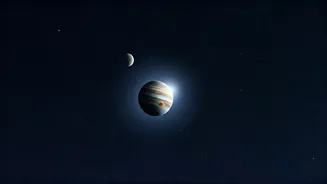
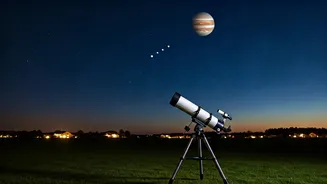
When you point a telescope at Jupiter, you’re not just seeing one object. You’re seeing a miniature solar system. Flanking the planet are four points of light, often lined up in a neat row. These are the Galilean moons—Io, Europa, Ganymede, and Callisto—discovered
by Galileo Galilei in 1610. His observation that they orbited Jupiter, not Earth, was a revolutionary blow to the geocentric model of the universe. What you can see tonight is that same cosmic ballet. The moons constantly change position as they orbit the gas giant, appearing on different sides of the planet from one night to the next. A “transit” is when one of these moons, or its shadow, passes in front of Jupiter’s cloudy face. Seeing the moon itself against Jupiter’s bright surface is tough, but seeing its tiny, black shadow slowly creep across the planet is a genuinely thrilling event for a backyard astronomer.
What 'Basic Telescope' Really Means
The headline’s promise of a “basic backyard telescope” holds up, but let’s manage expectations. A good pair of 10x50 binoculars, held very steady or mounted on a tripod, is enough to resolve Jupiter from a star into a tiny disk and spot its four brightest moons as pinpricks of light. To see the moons clearly and maybe even glimpse Jupiter’s two main cloud bands, you’ll want a small telescope. A 60mm to 80mm refractor or a 4.5-inch reflector telescope—often sold as beginner scopes for a few hundred dollars—is more than capable. These will transform the moons from faint dots into distinct, sharp orbs. To see a shadow transit, you’ll benefit from a slightly larger scope (a 6-inch reflector or bigger) and good, steady air. The key isn't necessarily spending a fortune; it’s about using your equipment to its full potential.
Finding the King of Planets
For much of the year, Jupiter is one of the brightest objects in the night sky, outshone only by the Moon and Venus. This makes it incredibly easy to find. You don't need a star chart, though one never hurts. Simply go outside after dusk and look for the brightest, most steadfast “star” that isn’t twinkling. Planets tend to shine with a more stable light than distant stars. Jupiter’s current position makes it a prominent feature in the evening sky. To get its exact location, use a simple sky-viewing app on your phone like SkyView Lite, Stellarium, or Star Walk. Just point your phone at the sky, and the app will identify Jupiter for you instantly. Once you have it in your sights, you can point your binoculars or telescope right at it.
Tips for a Better View
Your biggest challenge won’t be your telescope—it will be Earth’s atmosphere. Turbulent air makes celestial objects appear to shimmer or boil, blurring fine details. This is what astronomers call “seeing.” For the best view, wait for Jupiter to rise higher in the sky, away from the turbulent air near the horizon. Let your telescope sit outside for at least 30 minutes before you use it; this allows the optics to acclimate to the ambient temperature and prevents internal air currents from distorting the view. Finally, practice patience at the eyepiece. Your eye needs time to adjust to the subtle details. What seems like a fuzzy ball at first can resolve into a striped planet with orbiting moons after a few minutes of focused observation.
Catching a Shadow Transit
While you can stumble upon the Galilean moons any clear night, catching a shadow transit requires a bit of planning. These events happen frequently but are only visible when they occur on the side of Jupiter facing Earth, during our nighttime. Luckily, you don't have to guess. Websites like Sky & Telescope and apps like JupiterMoons for iOS or Celestron’s SkyPortal can provide you with exact timetables for transits visible from your location. When a transit is happening, you’ll be looking for a tiny, perfectly black dot moving slowly across Jupiter’s disk. It’s a subtle but deeply rewarding sight—a tangible reminder of the vast, clockwork mechanics of our solar system playing out in real time.