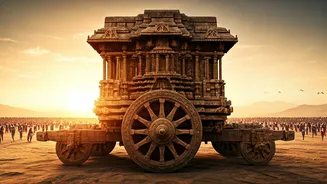









A Spectacle of Unfathomable Scale
Imagine a moving sea of over a million people. That's the baseline for the Puri Rath Yatra, or Chariot Festival. It’s one of the largest peaceful gatherings on the planet. For nine days each summer, the city of Puri in the eastern Indian state of Odisha
transforms into a sprawling nexus of faith. The air thickens with the sounds of chanting, cymbals, and drums as devotees from every corner of the globe converge. This isn't a spectator sport; it’s an act of mass participation. The sheer energy generated by a million-plus people focused on a single, devotional act is something that can't be captured on video—it has to be felt in your bones.
The Original Juggernauts
Ever wonder where the word 'juggernaut'—meaning an unstoppable, overwhelming force—comes from? This festival is the answer. It’s an English corruption of 'Jagannath,' the primary deity of the festival. Lord Jagannath, along with his elder brother Balabhadra and sister Subhadra, are transported on three colossal, temple-like chariots. These are not parade floats. Each is a multi-ton marvel of engineering and artistry, standing over 40 feet tall and built fresh every single year from specified wood by designated families of artisans. Pulled by thousands of devotees using thick coir ropes, the sight of these immense structures rumbling through the packed streets is the very definition of a 'juggernaut' in motion.
A Journey of Divine Connection
At its heart, the Rath Yatra is a deeply personal spiritual journey enacted on a massive public scale. The story is beautifully simple: the deities are leaving their main temple for their annual 'vacation' to their aunt's temple, the Gundicha Temple, about two miles away. For devotees, this is a rare chance to see the gods outside their sanctuary. The act of pulling the chariots' ropes is considered an act of immense piety, a way to directly serve and connect with the divine. The belief is that participating in the festival, even just by witnessing it, can cleanse one of sins and bring spiritual merit, creating an atmosphere charged with profound emotion and devotion.
An Expression of Radical Inclusivity
The Jagannath Temple in Puri famously restricts entry to practicing Hindus. However, during the Rath Yatra, these rules are suspended. As the deities come out onto the Grand Road ('Bada Danda'), they are visible to everyone, regardless of faith, caste, or creed. This tradition makes the festival a powerful symbol of unity and equality. In a world often divided by religious lines, the Rath Yatra offers a moment where the divine is accessible to all, breaking down barriers in a massive, public display of inclusion. It's a reminder that spirituality can be a unifying force, drawing people together rather than pushing them apart.
A Living Link to Ancient History
While many modern festivals are recent inventions, the Rath Yatra is a continuous tradition with historical mentions dating back well over a thousand years. Its rituals, routes, and the families who perform specific duties (like building the chariots or serving the deities) have been passed down through countless generations. To witness the Rath Yatra is to see a piece of ancient history come alive. It's a cultural institution that has survived empires, colonization, and the crush of modernity, retaining its core purpose and spiritual power. It’s not a reenactment; it’s the real, unbroken thing, offering a tangible connection to a deep and resilient past.