



The Classic: English Ivy
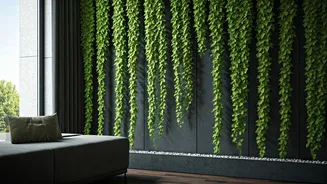
When you picture a trailing plant, English Ivy (Hedera helix) is likely what comes to mind. With its classic, lobed leaves and vigorous growth, it delivers a timeless, old-world charm. It’s perfect for draping elegantly over a fireplace mantel, cascading
down a tall bookshelf, or framing a window. English Ivy thrives in bright, indirect light but is surprisingly tolerant of lower-light conditions, making it versatile for various spots in a living room. Keep its soil consistently moist but not waterlogged, and be prepared to prune it back occasionally, as its vines can grow several feet long in a single year. A crucial note for pet owners: English Ivy is toxic to cats and dogs if ingested, so it’s best kept well out of reach.
The Unkillable Beginner Plant: Pothos
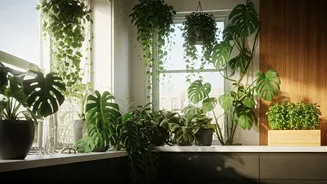
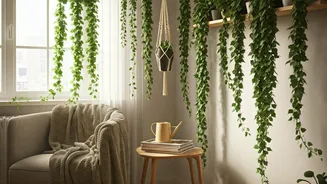
Often mistaken for ivy, Pothos (Epipremnum aureum) is the go-to for anyone who claims to have a “black thumb.” This plant is famously resilient, forgiving, and an excellent air purifier. Its heart-shaped leaves come in a range of beautiful variations, from the classic Golden Pothos with yellow variegation to the speckled Marble Queen and the silvery Satin Pothos. It’s incredibly adaptable, happy in anything from low to bright, indirect light. Water it thoroughly when the top inch or two of soil feels dry. Pothos is a fast grower that looks stunning in a hanging macrame planter or placed on a high shelf where its vines can trail freely toward the floor. Like English Ivy, Pothos is toxic to pets, so placement is key.
The Romantic One: Heartleaf Philodendron
A close cousin of the Pothos in terms of care, the Heartleaf Philodendron (Philodendron hederaceum) offers a slightly softer, more romantic aesthetic. Its leaves are a deep, uniform green and have a distinctly thinner, more delicate heart shape with a velvety texture. This plant communicates its needs clearly—its leaves will droop when thirsty and perk right back up after watering. It prefers medium to bright, indirect light but can handle lower light levels. The Heartleaf Philodendron is perfect for creating a lush, jungle-like feel. Try training its vines up a small trellis against a wall or letting them spill over the sides of a console table for a touch of living art. It is also toxic to cats and dogs.
The Modern Accent: String of Pearls
For a more modern, sculptural look, String of Pearls (Senecio rowleyanus) is a showstopper. This unique succulent features long, delicate tendrils of pea-like leaves that spill over the pot's edge. Unlike the leafy vines above, it brings a minimalist and quirky vibe to a room. As a succulent, its care is different: it demands bright, direct sunlight for several hours a day and very little water. Place it in a south-facing window and water only when the soil has dried out completely to prevent root rot. Its unique form makes it a perfect “statement plant” in a small hanging pot or on a sunny floating shelf where its beaded strands can be fully appreciated. Unfortunately, this beauty is also toxic to pets.
The Pet-Friendly Darling: String of Hearts
Finding a beautiful trailing plant that’s safe for your furry friends can be a challenge, but String of Hearts (Ceropegia woodii) is the perfect solution. This delicate, non-toxic vine features tiny, heart-shaped leaves with beautiful silver variegation on long, wiry stems. It has a whimsical, dainty appearance that works well in modern and bohemian decor alike. It thrives in bright, indirect light and, like a succulent, prefers to dry out between waterings. Its trailing stems can grow incredibly long, making it a fantastic choice for a hanging basket where its patterned leaves can catch the light. It's a low-maintenance plant that provides peace of mind for pet owners.
Tips for Styling Your Vines
The magic of trailing plants lies in their placement. Don’t just leave them on a low table. Elevate them to let gravity do its work. Place them on top of tall cabinets, armoires, or bookshelves to create a green waterfall effect. Use hanging planters at different heights in a corner to build a floating garden. You can also use small, clear adhesive hooks to guide vines up and around a doorway, a mirror, or a piece of art, effectively drawing with greenery. This technique turns a simple plant into a dynamic architectural feature.