






First, What’s a Quasar?
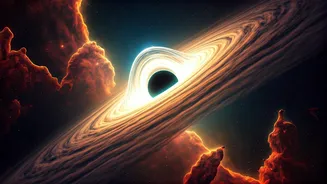
Before we get to the “monster winds,” let’s talk about the engine creating them: a quasar. Think of a quasar not as an object, but as an event. At the heart of most large galaxies, including our own Milky Way, lies a supermassive black hole—a gravitational
behemoth millions or even billions of times the mass of our sun. Most of the time, these giants are dormant. But when a galaxy is rich with gas and dust, this material can get pulled into a swirling, superheated traffic jam around the black hole called an accretion disk. As this material spirals inward, friction and gravitational forces heat it to millions of degrees, causing it to shine brighter than all the stars in its host galaxy combined. This brilliant, temporary beacon, powered by a feeding black hole, is what astronomers call a quasar.
Not Just Wind, a Galactic Tsunami
While many quasars produce outflows, the one emanating from J2318+0853 is in a class of its own. Using the powerful Gemini North telescope in Hawaii, a team of astronomers measured winds being blasted away from the quasar’s central black hole at astonishing speeds—around 1/10th the speed of light. That’s more than 60 million miles per hour. At that velocity, you could travel from New York to Los Angeles in about a tenth of a second. But what makes these winds truly “monstrous” is not just their speed, but their breadth. This isn't a narrow, focused jet of energy. It's a massive, galaxy-wide tsunami of gas being violently expelled in all directions. The sheer scale of this outflow is what stunned researchers; it’s a physical force strong enough to influence the entire galaxy it inhabits, pushing material far out into intergalactic space.
A Cosmic Speed Gun
So how do you clock the speed of a wind happening billions of light-years away? Scientists become cosmic detectives. They don’t see the wind itself, but its effects on the light traveling from the quasar. Using an instrument called a spectrometer, they break the quasar’s light into its component colors, like a prism creating a rainbow. Within this spectrum, specific elements—like the gas being blown around—leave a unique “fingerprint.” In the case of J2318, the fingerprint of this gas was dramatically shifted towards the blue end of the spectrum. This phenomenon, known as blueshift, is a consequence of the Doppler effect (the same reason an ambulance siren sounds higher-pitched as it approaches you). The extreme degree of this shift allowed astronomers to calculate the incredible velocity of the gas being hurled directly toward us.
The Galaxy's Thermostat
This discovery is more than just cosmic sightseeing; it helps solve a major puzzle in astronomy. If galaxies are the cosmic cities where stars are born, then cold gas is the raw building material. Logically, the biggest galaxies should form the most stars and just keep getting bigger. But they don't. Astronomers have long suspected that something puts the brakes on star formation in massive galaxies. These monster winds are a prime suspect. This process, called “quasar feedback,” acts like a galactic thermostat. By blasting the cold, star-forming gas out of the galaxy, the supermassive black hole is effectively shutting down its own food supply and sterilizing the galaxy, preventing new stars from being born. It’s a violent, dramatic form of self-regulation that shapes the very destiny of a galaxy.