




Welcome to the Abode of Clouds
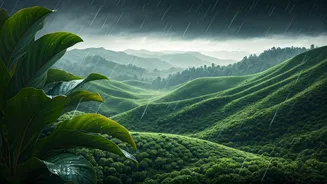
To understand these two monsoon titans, you first need to meet their stage: Meghalaya, a state in northeastern India whose name literally translates to “the abode of clouds.” Tucked into the Khasi Hills, this region has a unique geographical cheat code
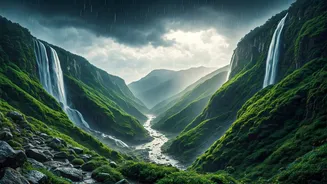
for rain. When the moisture-heavy winds of the Bay of Bengal monsoon travel north, they are funneled and forced upward by the hills. As the air rises, it cools and condenses, dumping unimaginable amounts of water onto the land below. This isn't your average spring shower; it's a relentless, world-defining deluge that lasts for months. For the local Khasi people, this isn’t a weather event; it's the rhythm of life itself.
The Reigning King: Mawsynram
Meet the current titleholder. Mawsynram officially holds the Guinness World Record for the highest average annual rainfall. We're talking about an average of 467.4 inches of rain per year. For perspective, Seattle gets about 38 inches. The sound of rain here isn't a gentle pitter-patter; it's a deafening roar that forces schools to line their roofs with soundproofing materials. Life in Mawsynram is a masterclass in adaptation. Locals use `knups`, body-sized umbrellas woven from bamboo and banana leaves, that function like personal weather shields, freeing up their hands for work. It's a place where the landscape is perpetually lush, green, and shrouded in a mystical fog, a village that has built its entire existence around being soaked.
The Famous Predecessor: Cherrapunji
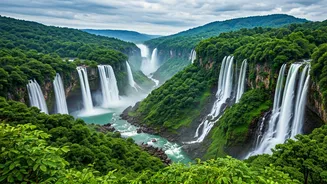
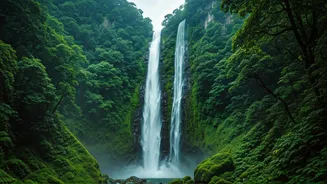
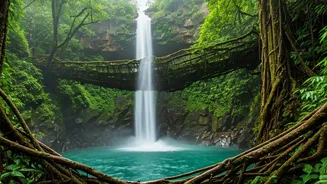
Just 10 miles away sits Cherrapunji, locally known as Sohra. For decades, Cherrapunji was the most famous wet spot on the planet, the name schoolchildren learned in geography class. While Mawsynram has since edged it out in the annual average rainfall competition, Cherrapunji is still a heavyweight. It holds the record for the most rainfall in a single calendar year—a mind-boggling 1,042 inches back in 1861. Some argue Cherrapunji has better PR; it’s more accessible to tourists and boasts some of the region's most spectacular sights. Its waterfalls, like the stunning Nohkalikai Falls, are at their most dramatic during the monsoon, and it's the gateway to viewing the region's most famous innovation: the living root bridges.
A Hyper-Local Rivalry
The Mawsynram vs. Cherrapunji debate is a hyper-local, meteorological Super Bowl. The numbers are incredibly close, and the title can feel like it's up for grabs depending on the year's monsoon patterns. Mawsynram’s geographical position gives it a slight edge, as it's more directly in the path of the moisture-laden winds. But Cherrapunji experiences a longer dry season, which makes the contrast of its monsoon even more intense. Ultimately, arguing over which is “wetter” is like debating whether a volcano is hotter than magma. Both are extreme, awe-inspiring examples of nature's power, and their proximity makes the phenomenon even more remarkable.
Living With the Rain
For the people here, the monsoon isn't a nuisance to be endured but a force that shapes culture, architecture, and even biology. The most famous example is the living root bridges, a marvel of bio-engineering. Instead of building wooden bridges that would quickly rot in the dampness, the Khasi people learned to guide the aerial roots of rubber fig trees across rivers, weaving them together over decades to form strong, living structures that only get more durable with time and rain. It’s a powerful symbol of their philosophy: don't fight the water, work with it. This ingenuity defines life in the wettest corner of the world, turning a challenge into a unique and resilient identity.