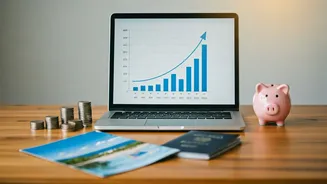






The Core Strategy: A Dedicated Growth Fund
The concept is simple: instead of letting money sit in a low-yield savings account, you create a separate investment account dedicated solely to your travel goal. Each month, a fixed amount of money is automatically transferred from your bank account and
invested into one or more mutual funds. You are essentially building a travel-specific portfolio.
This isn't for a spontaneous weekend trip. This strategy is designed for a significant, planned expense that is at least two to five years away. The time horizon is crucial because it allows your investments to potentially grow and recover from the market's inevitable short-term dips. Think of it as a purpose-built engine for funding a major life experience.
Why Mutual Funds, Not Just Savings?
A high-yield savings account is a fantastic tool for an emergency fund or short-term goals. It's safe, insured, and liquid. However, with inflation often outpacing the interest rates on even the best savings accounts, your purchasing power can actually decrease over time.
Mutual funds, on the other hand, offer the potential for growth that outpaces inflation. A mutual fund is a professionally managed portfolio of stocks, bonds, or other assets. By buying into one, you get instant diversification without having to pick individual stocks yourself. This diversification helps mitigate the risk of any single company’s poor performance sinking your entire fund. The trade-off, of course, is that mutual funds carry market risk and are not FDIC-insured; their value can go down as well as up.
The Power of Automation and Consistency
The 'monthly allocation' part of the headline is the secret sauce. By setting up automatic, recurring investments, you remove two major obstacles: the temptation to spend the money elsewhere and the emotional impulse to 'time the market.'
This technique is known as dollar-cost averaging. When you invest a fixed amount of money at regular intervals, you buy more shares when the price is low and fewer shares when the price is high. Over time, this can result in a lower average cost per share compared to investing a lump sum. More importantly, it automates discipline. You treat your travel fund like any other monthly bill, ensuring you consistently work toward your goal without having to think about it.
Setting a Realistic Goal and Timeline
Before you invest a dime, you need a plan. First, research the approximate cost of your dream trip. Be generous with your estimate to account for inflation and unexpected expenses. Let's say you need $15,000 for a two-week European tour in three years.
Once you have your target number ($15,000) and timeline (36 months), you can work backward. If you were just saving, you'd need to put away $417 per month. By investing, you might be able to contribute less and let market growth do some of the heavy lifting. A conservative financial planner might model a 5-7% average annual return. Using this as a guide, you can calculate a more reasonable monthly contribution. This turns a vague dream into a concrete plan with measurable milestones.
The Exit Strategy: Cashing Out for Your Trip
As your departure date nears, you need to think about turning your investments back into cash. It's wise to begin liquidating the funds—selling the shares—several months before you need to book flights and hotels. This protects you from being forced to sell during a sudden market downturn.
Crucially, you must account for taxes. When you sell mutual fund shares in a standard brokerage account for a profit, that profit is considered a capital gain. If you've held the shares for more than a year, it's taxed at the more favorable long-term capital gains rate. If you've held them for a year or less, it's taxed as ordinary income, which is a much higher rate. Factor this tax bill into your initial savings goal to avoid a last-minute shortfall.