




Beyond the Digital Worksheet
For years, “online learning” often meant little more than digital versions of static textbooks or fill-in-the-blank worksheets. A student would answer questions, get a score, and maybe a link to a generic explanation. But a fundamental shift is underway,
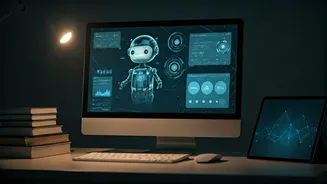
powered by artificial intelligence. The new generation of EdTech tutors doesn't just present information; it interacts with the student in a way that mimics a patient, observant human educator. These AI systems are designed to move beyond a one-size-fits-all approach. Instead of forcing every student down the same linear path, they create a unique journey for each learner, identifying strengths and weaknesses in real time. This is the end of the passive digital experience and the dawn of truly interactive, adaptive learning.
How Does the AI Know?
The secret lies in a concept called dynamic difficulty adjustment. Think of it like a video game that gets harder as your skills improve, but in this case, the “game” is a math problem, a language lesson, or a science concept. When a student starts a session, the AI tutor presents a baseline question. If the student answers correctly and quickly, the system recognizes a level of mastery and serves up a more challenging problem. If the student struggles, the AI doesn't just mark the answer wrong; it analyzes the type of mistake. Did they misunderstand a core concept? Is it a simple calculation error? Based on this analysis, the AI can offer a targeted hint, link to a foundational video, or present a simpler, prerequisite problem to help build the necessary skill before trying again. It’s a constant feedback loop of assessment and adjustment, all happening instantly and invisibly.
The Promise of Personalized Pacing
The most significant benefit of this technology is its ability to cater to individual learning speeds. In a traditional classroom of 30 students, it's impossible for one teacher to perfectly pace a lesson for everyone. Some students get bored and disengage because the material is too easy, while others fall behind and become discouraged because it’s too difficult. AI tutors solve this problem by allowing each student to progress at their own pace. A gifted math student can race ahead through the curriculum, while a student struggling with fractions can spend as much time as they need with the AI providing endless practice problems and gentle, non-judgmental corrections. This has the potential to not only close learning gaps but also foster a genuine love of learning by reducing the anxiety and frustration associated with falling behind or the boredom of waiting for others to catch up.
A Tool, Not a Teacher Replacement
Despite the futuristic promise, it’s crucial to view these AI tutors as powerful tools, not replacements for human teachers. Educators provide something AI cannot: empathy, mentorship, and the ability to inspire. A great teacher can read a student’s body language, understand their home-life context, and foster the social and emotional skills essential for success. The ideal role for an AI tutor is as a tireless teaching assistant. It can handle the repetitive work of drilling multiplication tables or grammar rules, freeing up the human teacher to focus on higher-order thinking, collaborative projects, and one-on-one mentoring with students who need it most. Furthermore, important questions about data privacy, algorithmic bias, and ensuring equitable access to these tools must be addressed as they become more integrated into our education system. An over-reliance on any single technology could also inadvertently weaken other crucial learning modes, like hands-on experimentation and peer-to-peer discussion.