




A Divine Procession of Epic Proportions
Every year, in the coastal town of Puri in the eastern Indian state of Odisha, one of the world's most staggering religious spectacles takes place. The Rath Yatra, or Chariot Festival, is an ancient Hindu event celebrating Lord Jagannath—a revered form
of the god Vishnu—and his annual journey with his elder brother Balabhadra and younger sister Subhadra. This isn’t a parade in the Western sense; it's a deeply sacred public ritual. The deities, who are normally housed deep within the sanctum of the 12th-century Jagannath Temple, are brought out into the open, giving people of all backgrounds and faiths a chance to see them. This act of grace, where the gods come to the people, is the spiritual core of the festival.
God's Own Moving Temples
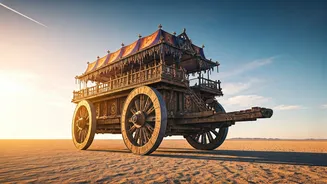
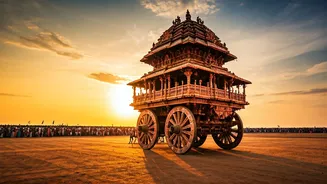
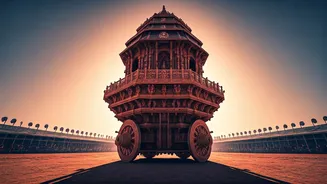
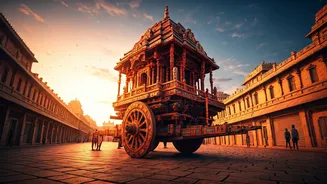
The term 'chariot' hardly does justice to these structures. Each is a towering, mobile temple, built anew every year from specific types of wood by a dedicated lineage of carpenters. Lord Jagannath’s chariot, Nandighosa, stands about 45 feet tall, rolling on sixteen massive wheels and draped in vibrant red and yellow cloth. His brother Balabhadra’s chariot, Taladhwaja, is nearly as tall, covered in red and green, while their sister Subhadra’s, Darpadalana, is cloaked in red and black. These are not merely vehicles; they are intricately decorated works of art, adorned with carvings, paintings of deities, and brass fixtures that glitter in the sun. The sheer scale is breathtaking, a testament to centuries of tradition and craftsmanship passed down through generations. Seeing them for the first time feels like watching mythical structures from an epic tale come to life.
The Human Sea of Devotion
The true power of the Rath Yatra, however, lies in its people. A crowd estimated to be over a million strong floods the Grand Road of Puri. They come from every corner of India and across the globe. The air is thick with the sounds of rhythmic chanting, the clang of cymbals, and the blowing of conch shells. Devotees surge forward, desperate to grasp the thick coir ropes, which are several hundred feet long, to help pull the chariots. It’s believed that pulling the divine chariots, or even just touching the ropes, is an act of immense piety that can wash away sins. The energy is overwhelming—a fusion of joyous celebration, intense devotion, and communal effort. It's a raw, unfiltered expression of faith on a scale that has few parallels in the modern world. You don’t just watch the Rath Yatra; you feel it in your bones.
The Journey to a Celestial Aunt's Home
The festival marks a nine-day vacation for the deities. The procession slowly makes its way along the roughly two-mile route from the main Jagannath Temple to the Gundicha Temple, which is considered the celestial 'aunt's house' of the gods. The journey, which should take minutes by car, can last for hours or even stretch into the next day, as the chariots stop and start amidst the crushing wave of humanity. After a week-long stay at the Gundicha Temple, the deities make their return journey, known as the Bahuda Yatra, back to their primary residence. This narrative of the gods taking a holiday, visiting relatives, and returning home adds a charming, relatable dimension to the divine proceedings, making the deities feel both majestic and accessible.
More Than a Festival, It's an Experience
So why is this a bucket-list moment? Because the Rath Yatra transcends tourism. It's an immersion into a living tradition that has remained largely unchanged for centuries. It’s a sensory overload in the best possible way—a collision of color, sound, and raw human emotion. To stand on the Grand Road in Puri is to witness the intersection of art, architecture, faith, and community on a truly epic scale. It’s a reminder that some of the most profound human experiences are shared, collective endeavors. It’s not about finding a quiet, contemplative moment. It’s about losing yourself in a million-strong crowd, united by a single, powerful current of belief and celebration.