




So, What Exactly Is Rath Yatra?
At its heart, Rath Yatra (pronounced *ruth-yaa-traa*) is the “Festival of Chariots.” It’s an annual Hindu festival celebrating Lord Jagannath, a revered form of the god Vishnu. The main event takes place in the coastal city of Puri, home to the ancient
Jagannath Temple. For one week, Lord Jagannath, along with his elder brother Balabhadra and sister Subhadra, leave the inner sanctum of their temple to travel to their aunt’s home, the Gundicha Temple, a couple of miles away. It’s a symbolic journey that allows the deities, normally cloistered away, to be seen by everyone, regardless of caste or creed. For devotees, this is an intensely spiritual event, as catching a glimpse of the deities on their chariots is considered incredibly auspicious.
The Stars of the Show
The deities themselves are one of the most striking aspects of the festival. Unlike typical Hindu idols, the figures of Jagannath, Balabhadra, and Subhadra are carved from wood with large, round eyes, no discernible limbs, and bold, blocky features. This unique, abstract form has deep theological roots, representing a primordial, all-encompassing divine presence. Lord Jagannath is identified by his black face and large circular eyes, Balabhadra by his white face, and their sister Subhadra by her yellow face and smaller stature. These sacred wooden idols are ceremonially replaced every 12 to 19 years in a highly sacred ritual known as Nabakalebara, adding another layer of mystique to the tradition.
Building the Unbelievable Chariots
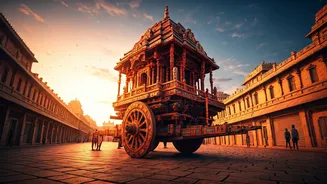
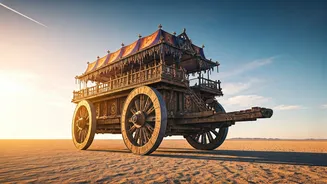
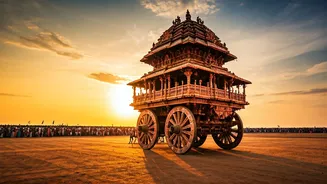
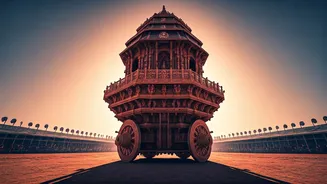
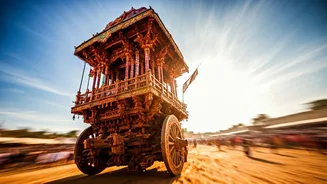
This isn't just a parade with a few floats. We're talking about three colossal, temple-like structures on wheels, each built fresh every single year by a dedicated team of carpenters using ancient, specified techniques—no blueprints, just generational knowledge. Lord Jagannath’s chariot, Nandighosa, stands about 45 feet tall and has 16 wheels. Balabhadra’s chariot, Taladhwaja, is a close second at 44 feet with 14 wheels. Subhadra’s chariot, Darpadalana, is the smallest at 43 feet with 12 wheels. These are enormous, brightly decorated wooden marvels, draped in canopies of red, green, black, and yellow cloth. The sheer scale and artistry are breathtaking, and seeing them move is a feat of both engineering and faith.
A Procession of a Million People
The festival's first day is when the magic happens. After a series of vibrant rituals, the deities are brought out of the temple in a swaying, ceremonial procession known as Pahandi. Then, the chariots begin their slow, deliberate journey. But they don’t move on their own. They are pulled by hundreds of thousands of devotees using massive, thick coir ropes. The streets of Puri become a river of humanity, with estimates ranging from one to two million people converging on the city. The air is filled with the sounds of gongs, cymbals, and chants of “Jai Jagannath!” (Victory to Jagannath). For those participating, touching the ropes is an act of service and devotion, believed to bring spiritual merit. It’s one of the largest peaceful religious gatherings in the world.
More Than Just One Day
While the first day’s journey is the most famous part, the “travel week” aspect of the headline refers to the full nine-day festival. Once the deities reach the Gundicha Temple, they remain there for seven days. During this time, the temple becomes a hub of activity, with devotees flocking to see the gods in their “holiday home.” The return journey, known as the Bahuda Yatra, is just as spectacular. Finally, the deities are returned to the main temple and adorned in stunning golden attire in a ritual called Suna Besha, drawing massive crowds once more. This entire cycle makes it a week-long immersion in culture, faith, and community.