






Life in the Orchard
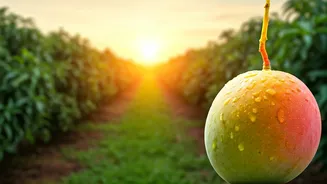
The story begins years, even decades, before the fruit is picked. Most mangos consumed in the U.S. start their lives on family-owned farms in Mexico, Peru, Ecuador, or Brazil. A mango tree is an investment in the future; it can take three to five years to bear
its first fruit and won't hit peak production for over a decade. In these tropical climates, groves of trees with dense, dark-green canopies stretch across the landscape. Growers tend to them year-round, managing irrigation, pruning branches to maximize sun exposure, and protecting the delicate blossoms that will eventually become fruit. The variety matters, too. The smooth, sweet Tommy Atkins, the fiberless Kent, the honeyed Ataulfo—each has its own unique growing season and characteristics, ensuring a nearly year-round supply for American consumers.
The Art of the Harvest
Unlike an apple you might pick ripe from a tree, commercial mangos are harvested when they are physiologically mature, but not yet ripe. This is the crucial distinction that makes their long journey possible. Experienced workers, often using long poles tipped with a cutting tool and a small basket, carefully select and snip each mango from its branch. It's a delicate, labor-intensive process. A dropped mango is a bruised mango, and a bruised mango is a loss. The harvesters look for subtle cues—a slight fullness in the fruit's “shoulders” near the stem, a specific shade of green—that signal it has enough internal sugar to ripen beautifully later. Once picked, the fruit is gently gathered and transported to a nearby packing house, where the race against the clock truly begins.
The Cold Chain
At the packing house, the mangos are given a hot water bath to prevent disease before being washed, sorted by size and quality, and packed into boxes. This is where modern logistics take over. The boxes are quickly moved into a pre-cooled storage area to lower their core temperature. This initiates the “cold chain,” an unbroken series of refrigerated environments—in trucks, on container ships, and in warehouses—that keeps the fruit in a state of suspended animation. By maintaining a steady temperature, typically around 50-55°F, suppliers slow the mango's natural ripening process to a crawl. This allows the fruit to travel thousands of miles over several weeks by sea or land without spoiling, arriving in the U.S. as a still-firm, green-hued product, full of potential.
The Final Ripening
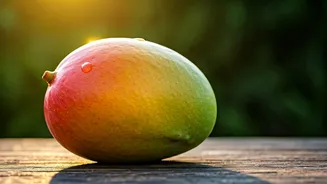
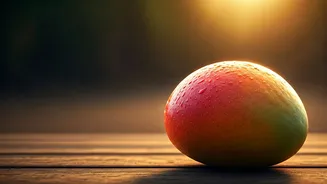
Upon arrival at a U.S. distribution center, the mangos are brought out of their cold slumber. While some are sent directly to grocery stores to ripen on the shelf (or on your counter), many are moved to special “ripening rooms.” Here, they are warmed to a more tropical temperature and exposed to ethylene, a harmless natural plant hormone that fruit produces to ripen itself. This controlled process ensures that a large batch of mangos ripens uniformly and predictably. It’s how a supermarket can stock perfectly conditioned, ready-to-eat fruit day after day. After a few days in this environment, the starches convert to sugar, the flesh softens, and the skin develops that signature sunset blush. Finally, they are shipped that last mile to your local grocer, ready for the feast.