



A Beacon from the Dawn of Time
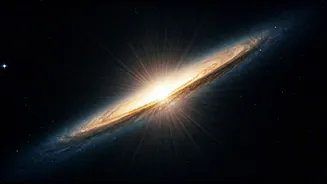
First, let’s get our terms straight. A quasar isn’t a star. It’s something far more violent and spectacular. At the heart of most large galaxies, including our own Milky Way, lurks a supermassive black hole. Most of the time, these cosmic monsters are
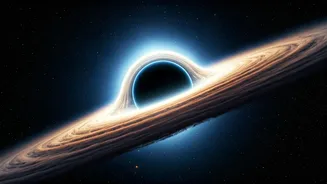
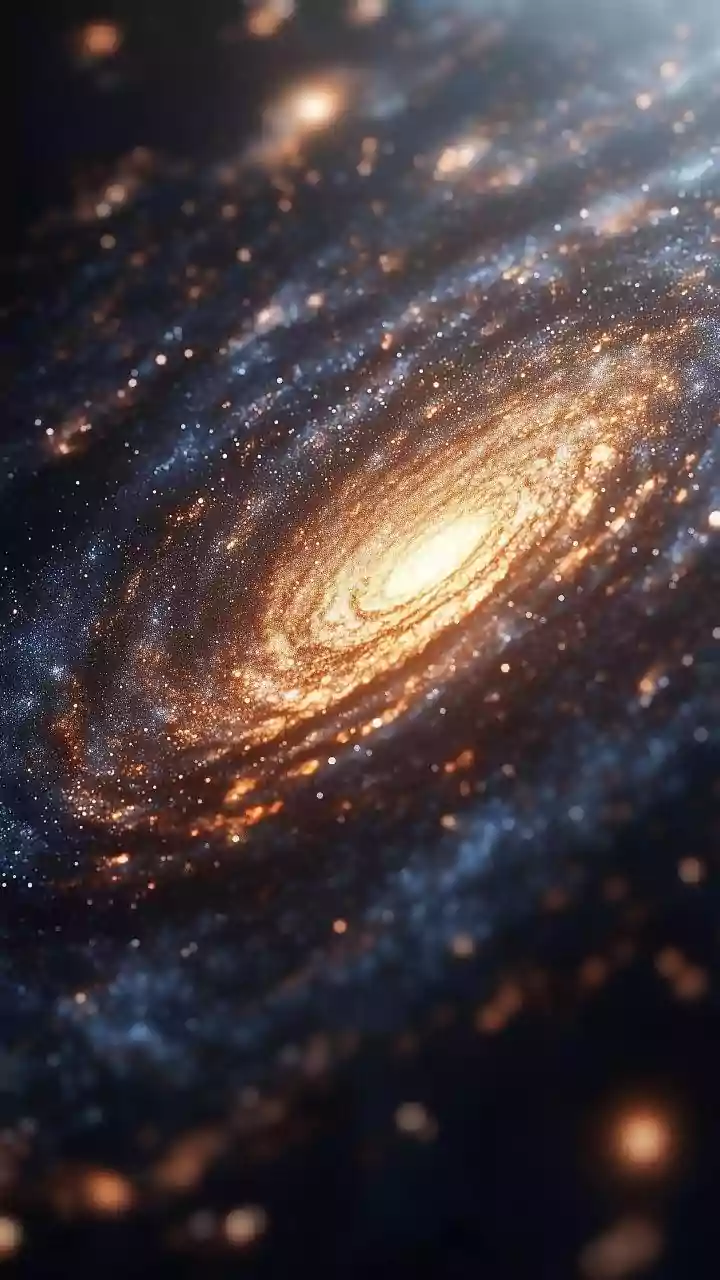
quiet. But in the early universe, when gas and dust were plentiful, some of them went on a feeding frenzy. As a black hole devours surrounding material, the matter gets superheated in a swirling structure called an accretion disk, unleashing an unbelievable amount of energy. This process creates a 'quasi-stellar object,' or quasar—an object so luminous it can be seen from billions of light-years away. In fact, the quasar itself is just the tiny, bright core, but it completely outshines the light of the hundreds of billions of stars in its host galaxy. They are, quite literally, the brightest beacons from the universe’s distant past.
Decoding the Cosmic Flicker
Here’s where the 'flickering' comes in, and it's the key to the new research. A quasar’s light isn’t perfectly steady. It varies, or 'flickers,' over days, months, and years. This isn't random noise; it's a cosmic Morse code. Think of it like a campfire: the way the flames dance and sputter tells you about the type of wood burning, how much fuel is left, and how the wind is blowing. For astrophysicists, a quasar’s flicker reveals crucial information about the central black hole. By meticulously tracking these tiny changes in brightness, researchers can deduce the black hole’s mass, how quickly it’s consuming matter, and the structure of the chaotic environment surrounding it. For a long time, this was difficult to do for the most distant quasars. But with powerful new tools like the James Webb Space Telescope (JWST), scientists can now capture this flicker from the dawn of time with unprecedented clarity.
A Glimpse of a Cosmic Toddler
Led by researchers at MIT, a team of astronomers has done just that. They’ve focused on some of the earliest quasars ever detected, whose light has traveled for over 13 billion years to reach us. We are essentially seeing these objects as they were when the universe was less than a billion years old—a mere toddler in cosmic terms. By applying their models of flickering to the data gathered by the JWST, the MIT team was able to 'map' the properties of one of these ancient giants. They measured its black hole's mass and its voracious appetite. The process is a masterpiece of cosmic detective work, combining cutting-edge observational power with sophisticated theoretical models to weigh an object that existed before the Earth was even formed.
Rewriting the Cosmic Rulebook
So, why does this matter? Because the results are puzzling. The quasars being found in the early universe are shockingly massive. According to our classic models of how black holes form and grow, they shouldn’t have had enough time to get that big, that fast. Finding a billion-solar-mass black hole in the first billion years of the universe is like finding a fully grown redwood tree that’s only a year old. It suggests that something is missing from our understanding. Either the 'seeds' of black holes were much larger than we thought, or they grew through some exotic, hyper-efficient process we haven't yet accounted for. By mapping these early, flickering quasars, the MIT researchers are providing the hard data needed to solve this cosmic chicken-and-egg problem. Each measurement helps refine our theories about how the first galaxies and their central black holes came to be, fundamentally shaping the universe we live in today.