






Why Consistency Is Your Plant's Best Friend
The promise of "perfect health" for any living thing is a tall order, but the secret to happy indoor plants isn't magic—it's consistency. Plants, like people, thrive on routine. They have internal clocks, a process called photoperiodism, that tells them
when to grow, when to rest, and even when to flower. In the wild, this rhythm is dictated by the sun. In a dark apartment, that natural rhythm is lost. This is where many well-intentioned plant parents fail; they either forget to turn on a grow light, or they leave it on for too long. An inconsistent light schedule stresses a plant, leading to yellowing leaves, stunted growth, and general unhappiness. Automating the light cycle with a smart plug removes the human error, providing the unwavering consistency that forms the bedrock of good plant health.
Your Automated Sunshine Toolkit
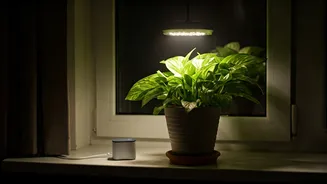
Getting started is surprisingly simple and affordable. You only need two key items: a grow light and a smart plug. For the grow light, choose one that fits your space and your plant's needs. Full-spectrum LED bulbs that can be screwed into any standard lamp are a fantastic, unobtrusive option. They provide the necessary light waves for photosynthesis without the heat or high energy use of older bulbs. Make sure the light you choose is rated for use with a timer; most simple on/off models are perfect. For the smart plug, the options are plentiful. Look for a reputable brand like Kasa, Wyze, or Meross. The most important feature is a reliable, easy-to-use app that allows you to set a daily on/off schedule. You don’t need the fanciest model with energy monitoring; a basic, Wi-Fi-enabled plug will do the job perfectly. The goal is to set it once and let it run automatically.
Setting Up Your 'Set It and Forget It' System
The setup process takes less than ten minutes. First, decide where your plant will live and position your lamp with the grow light bulb installed. Then, follow these simple steps: 1. Plug your lamp into the smart plug. 2. Plug the smart plug into the wall outlet. 3. Download the smart plug’s corresponding app on your smartphone. 4. Follow the app’s instructions to connect the plug to your home’s Wi-Fi network. 5. Once connected, navigate to the “Schedule” or “Timer” function in the app. Create a new schedule. For most low-light tolerant plants like Snake Plants, ZZ Plants, and Pothos, a 12-hour cycle is a great starting point. For example, you can set the plug to turn “On” at 7 a.m. and “Off” at 7 p.m. every day. That’s it. The plug will now manage the light cycle for you, day in and day out, whether you're home, on vacation, or just plain forgetful.
Best Practices for Low-Light Success
While this system is powerful, a few best practices will ensure you’re getting the most out of it. First, remember that supplemental light is meant to *supplement*, not completely replace, natural light where possible. Even a little ambient light from a distant window is beneficial. Second, resist the urge to run the light 24/7. Plants need a period of darkness to respire and carry out other essential functions. Constant light is just as stressful as no light at all. Finally, observe your plant. If you notice leaves seem to be bleaching or getting crispy, the light might be too intense or too close. If it’s still looking leggy and sad after a few weeks, try adding an extra hour or two to the daily schedule. This automated system gives you a stable baseline, making it easier to diagnose other issues like watering or pests.