
The Reign of the Rigid Frame
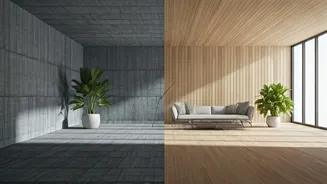
For the better part of a decade, a specific look ruled the roost. Call it industrial chic, modern farmhouse, or just peak-2010s minimalism. It was a world of sharp angles, black steel window frames, reclaimed wood tables with hairpin legs, and exposed
Edison bulbs hanging from stark cords. This aesthetic was born from a desire for authenticity and a nod to a romanticized, gritty urban past. It felt efficient, strong, and a little bit serious. It was the visual equivalent of hustle culture—clean, optimized, and built for purpose, with little room for frivolity. Every object had its place, and every line was clean. This was the design language of open-plan offices translated for the home, suggesting productivity and a no-nonsense approach to life.
Enter the Comfort Curve
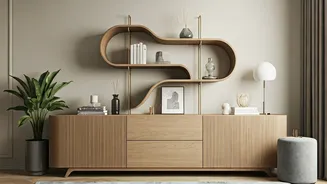
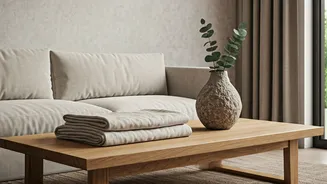
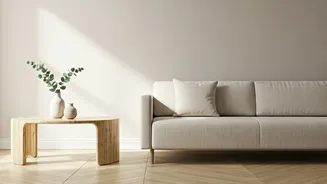
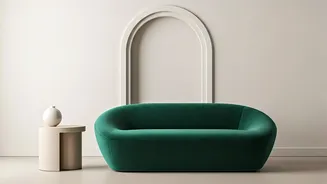
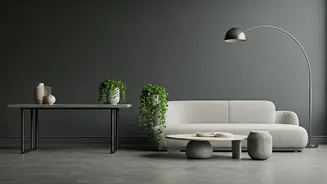
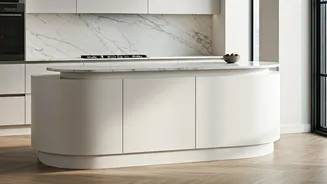
Now, a quiet revolution is underway. The straight line is bending. In its place are kidney-bean-shaped sofas, circular coffee tables, arched doorways and mirrors, and lighting that looks like glowing mushrooms or soft clouds. Fabrics have followed suit, with nubby bouclé and plush velvets covering these new, welcoming forms. This isn't just about adding a curved chair to a room; it’s a wholesale embrace of organic shapes that mimic forms found in nature and the human body. The new ideal home isn't a factory floor or a sterile gallery; it's a cozy, enveloping nest. The keyword is softness—not just in texture, but in form itself. The goal is no longer to impress with sharp, architectural precision, but to invite, comfort, and embrace.
A Search for Sanctuary After the Storm
So, why the sudden shift? A huge part of the story is the long shadow of the pandemic. As our homes became our offices, schools, gyms, and the sole location for our social lives, our needs fundamentally changed. We weren't just living in our homes; we were confined to them. That experience triggered a collective, deep-seated need for psychological comfort. Sharp, cold, minimalist spaces suddenly felt less chic and more clinical. We began craving a sanctuary—a safe, gentle space that could function as a psychological buffer against a chaotic world. Curves, with their lack of threatening points and their visually soothing flow, provided exactly that. A rounded sofa feels like a hug. An arched doorway feels like an embrace. This wasn't just redecorating; it was emotional self-preservation.
Our Brains Are Hardwired for Curves
The preference goes deeper than recent events. It taps into something primal. Neuro-aesthetics, the study of how our brains respond to art and design, shows that humans are generally drawn to curved lines over sharp ones. Jagged, angular shapes can subconsciously trigger a fear response, as they are associated with threats in nature—think sharp teeth, claws, or broken glass. Curves, on the other hand, are associated with safety, nature, and the maternal form. They are the shapes of hills, clouds, eggs, and the human body. This concept, often linked to biophilic design, suggests that incorporating natural shapes and patterns into our environment reduces stress and improves our well-being. By choosing a circular rug or a serpentine sofa, we are subconsciously telling our brains, "You are safe here. You can relax."
An Antidote to the Digital Grid
Finally, the move toward organic forms can be seen as a quiet rebellion against the tyranny of the digital world. Our lives are increasingly lived on screens, within the rigid, gridded layouts of apps and websites. We scroll through perfectly curated, geometrically aligned feeds. The real world, and the human experience, is messy, imperfect, and asymmetrical. Embracing furniture that is blob-like, uneven, and unapologetically organic is a way of reclaiming that humanity. It’s a vote for the tangible, the tactile, and the beautifully imperfect. A stiff, minimalist frame demands perfection and order. A soft, lumpy couch invites you to lounge, to be comfortable, to be human. It doesn’t ask you to be productive; it simply asks you to be.