






The Land of High Passes
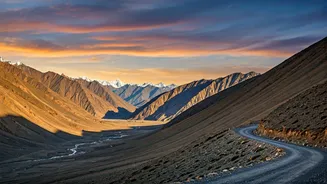
Tucked away in the northernmost reaches of India, Ladakh is a high-altitude desert cradled by the formidable Himalayan and Karakoram mountain ranges. Often called “Little Tibet” for its profound cultural and religious ties to its neighbor, this is a landscape
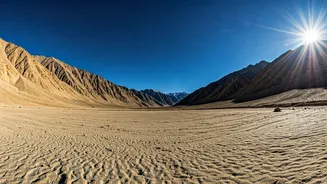
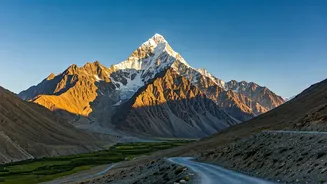
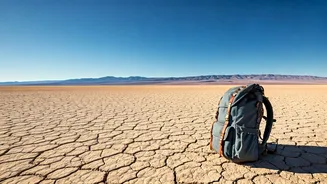
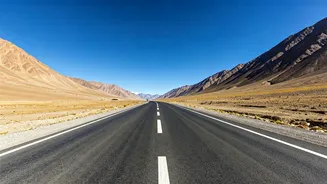
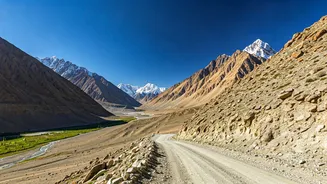
carved by wind and time. For the American traveler accustomed to lush forests or rolling plains, the visual language of Ladakh is startlingly different. It’s a world of raw, elemental beauty. The terrain is stark, with vast, barren plains punctuated by jagged peaks dusted with snow, even in summer. The air itself is a character in the story—thin, crisp, and so clear that distant mountains feel within reach. Reaching it requires a commitment, often involving a breathtaking flight into one of the world's highest airports in its capital, Leh, but the reward is an immediate sense of having arrived somewhere truly apart from the everyday.
Day's Fire, Night's Respite
The Ladakhi climate is one of dramatic contrasts. At altitudes averaging over 10,000 feet, the sun’s rays are unfiltered and intense. A summer day can feel surprisingly hot, baking the arid landscape and warming your skin as you explore ancient monasteries clinging to cliff sides. But the moment the sun dips below the towering peaks, the physics of the high desert takes over. With little humidity or cloud cover to trap the day’s warmth, heat radiates away into the atmosphere almost instantly. The temperature plummets. This is the origin of Ladakh’s famous “cool nights.” It’s not just a gentle evening chill; it's a refreshing, definitive shift from day to night. It’s the feeling of pulling on a fleece jacket after a day in a t-shirt, of gathering around a fire, of sipping hot butter tea as the world outside becomes crisp and still. This nightly plunge in temperature is a visceral reminder of your place in a powerful, untamed environment.
A Ceiling of a Million Stars
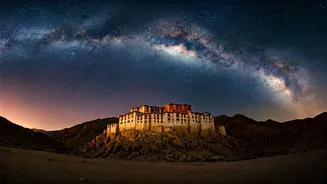
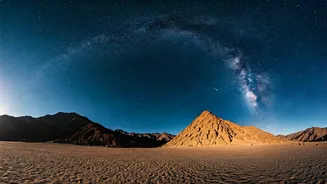
The same conditions that create Ladakh's cool nights—high altitude, dry air, and isolation from urban centers—also create its other great gift: the big sky. For anyone who has lived in or near a U.S. city, the night sky is often a hazy, orange-tinged dome with a few dozen visible stars. The Ladakhi sky is an entirely different universe. As dusk settles, the deep indigo canvas begins to pop with points of light, first a few, then hundreds, then an uncountable, glittering multitude. The sheer lack of light pollution means the Milky Way isn't a faint, wispy cloud; it's a brilliant, textured river of stars stretching from horizon to horizon. Constellations are not just connect-the-dots figures but dense clusters of brilliance. Meteors streak across the vastness with startling frequency. Lying back and gazing into this cosmic ocean is a profoundly humbling experience. It recalibrates your sense of scale, quieting the mind and offering a perspective that no screen can replicate.
More Than Just a View
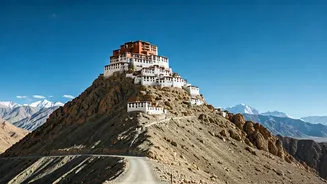
While the physical sensations are powerful, what truly defines a journey to Ladakh is how its environment shapes a state of mind. The silence isn't empty; it’s filled with the sound of wind whipping through prayer flags, their printed mantras sent out into the world with every gust. The landscape isn't just barren; it's a canvas for the mind to wander. This is a place where Buddhist monasteries, or gompas, have been centers of quiet contemplation for centuries, perched on impossible ridges as if to be closer to the heavens. The rhythm of life is slower, more deliberate. The combination of the invigorating cool air and the awe-inspiring celestial display fosters a sense of clarity and peace. It’s a destination that doesn’t just show you a different part of the world; it shows you a different part of yourself.