







The Heart of a Desert Kingdom
To understand Udaipur’s magic, you first have to understand its context. Located in Rajasthan, a state known for its vast deserts, Udaipur is an oasis—and not by accident. Founded in 1559 by Maharana Udai Singh II, the city was conceived around a system
of man-made lakes, primarily the magnificent Lake Pichola. This wasn't just for aesthetics; it was a brilliant strategic move, creating a fortified, self-sustaining capital in an arid landscape. But in solving a practical problem, the city's founders created something more: a soul. The lakes became the city’s heart, and every aspect of life began to orient itself toward the water, establishing a serene rhythm that continues to define Udaipur today.
Palaces That Seem to Float
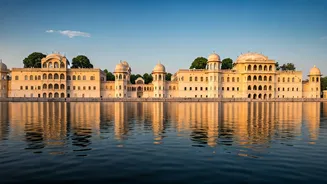
Nowhere is the city's romance more tangible than in the palaces that rise directly from the water. The most famous, the Lake Palace, sits like a marble mirage in the middle of Lake Pichola. Built in the 18th century as a royal summer retreat, it’s now one of the world's most iconic hotels, accessible only by boat. Its white-on-white courtyards and intricate latticework seem designed to catch the light reflecting off the waves. Nearby, Jag Mandir, another island palace, offers a similar sense of wonder. It served as a historic refuge for a future Mughal emperor and stands as a testament to the Mewar dynasty's architectural ambition. These are not just buildings on a lake; they are fantasies made real, structures that seem to defy the very boundary between land and water.
A View from the Shore
The romance isn't confined to the islands. On the eastern bank of Lake Pichola looms the City Palace, a sprawling complex of courtyards, pavilions, and gardens built over centuries. It’s one of the largest royal complexes in Rajasthan, but its genius lies in its intimacy with the lake. Nearly every balcony, terrace, and window is meticulously positioned to frame a breathtaking water view. As you wander through its corridors, the lake is a constant, calming presence. Below the palace, the *ghats*—stone steps leading down to the water—are hives of activity, where locals have gathered for centuries. From here, the Lake Palace and Jag Mandir appear as distant, dreamlike silhouettes, reinforcing the idea that the entire city was designed as one grand, water-centric work of art.
Dining Between Water and Sky
While history provides the foundation, modern Udaipur has perfected the art of leveraging its liquid assets for romance. The city is famed for its rooftop restaurants and heritage hotels, or *havelis*, converted from old noble mansions. As dusk settles, these rooftops come alive. Couples gather at candlelit tables on terraces overlooking the illuminated palaces. The gentle lapping of water from a boat ride below provides the soundtrack. This experience—dining between the dark, glassy water and a canopy of stars—is the quintessential Udaipur moment. It’s here that the city’s past and present merge. The view is the main attraction, a shared experience that connects you not only to the person across the table but also to centuries of Maharajas and empresses who gazed upon the very same scene.