






First, What Is a Quasar?
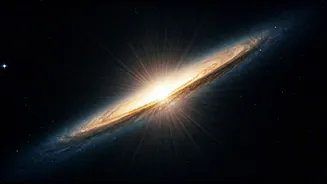
Before we get to the flickering part, let’s talk about quasars. Think of them as the universe’s most extreme lighthouses. A quasar isn’t a star; it’s a supermassive black hole, millions or even billions of times the mass of our sun, located at the center
of a distant galaxy. The reason it shines so brightly—often outshining its entire host galaxy—is that it’s in the middle of a cosmic feast. As immense amounts of gas, dust, and stars are pulled toward the black hole, they form a swirling, superheated disk around it. This accretion disk gets so hot and energetic from friction and gravitational forces that it blasts out incredible amounts of light and radiation across the entire electromagnetic spectrum. We see this light from billions of light-years away, which means we’re seeing the quasar as it existed billions of years ago.
The Cosmic Blink
Normally, a quasar’s brightness changes gradually over thousands or millions of years. But the one a team involving MIT astronomers found is different. This quasar, named J1007+2115, is what scientists call a “changing-look” quasar. Over a period of just a few years—a mere blink in cosmic time—its brightness plummeted dramatically. It’s as if someone flipped a dimmer switch on one of the most powerful objects in the universe. This “flickering” isn’t a gentle twinkle; it suggests a sudden, drastic change in the black hole’s feeding rate. One theory is that a thick cloud of dust may have rapidly moved into our line of sight, obscuring the quasar’s brilliant core. Another possibility is that the inflow of gas fueling the black hole was abruptly choked off. For an object this massive, such a rapid change is shocking and provides a rare, real-time look at the chaotic physics governing these cosmic monsters.
A Glimpse of the Cosmic Dawn
What makes this discovery a record-breaker is the “earliest known” part of the headline. The light from this flickering quasar traveled for 13 billion years to reach us. That means we are seeing it as it was when the universe was less than a billion years old—a period known as the “cosmic dawn,” when the first stars and galaxies were forming. Finding any quasar this old is a huge deal because it poses a major puzzle: How did a black hole get so mind-bogglingly massive, so quickly after the Big Bang? It’s like finding a fully grown redwood tree just a few years after the first seed was planted. Finding one that is also actively and rapidly changing its appearance provides an unprecedented laboratory for studying the volatile youth of the universe’s first supermassive black holes.
Why This Changes Everything
This discovery challenges our tidy models of black hole growth. For decades, many astronomers assumed that supermassive black holes grew steadily over eons, consistently gobbling up matter. But a rapidly changing-look quasar from this early epoch suggests their growth might be far more violent, sporadic, and inefficient than we thought. They might binge-eat for a few years, then abruptly stop or have their meal interrupted, causing them to “flicker” in brightness. This chaotic, stop-and-start process could fundamentally change our understanding of how galaxies and the black holes at their centers co-evolve. It implies that the early universe was an even more dynamic and turbulent place than we imagined, full of giant engines that could switch on and off in the cosmic blink of an eye.