







An Amphitheater of Gods
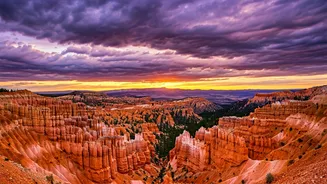
To stand at the railing of Sunset Point is to feel impossibly small. You’re not just looking at a canyon; you’re peering into a vast, silent amphitheater filled with stone sentinels. Below, thousands of crimson, orange, and pink rock spires, known as hoodoos,
stand in frozen formations. They have names like Thor’s Hammer and the Silent City, but even the most creative monikers fail to capture the sheer strangeness of the scene. On a typical sunny day, the view is dramatic, defined by sharp shadows and the brilliant Utah sun. It’s the image you see in every brochure, the one that tourists chase with their cameras held high. But it’s not the whole story. In fact, it might not even be the best one.
The Myth of the Perfect Sky
We’re conditioned to seek out clear, blue “bluebird” days for our national park adventures. We equate sunshine with success. Anything less feels like a compromise, a day where the weather simply refused to cooperate. But at Bryce Canyon, this logic is flipped on its head. The midday sun, especially in summer, can be brutally harsh. It bleaches the subtle colors from the Claron Formation rock, flattens the landscape’s depth, and casts deep, impenetrable shadows that hide as much as they reveal. The intense contrast makes photography a challenge and can overwhelm the eye, forcing you to squint against the glare rather than soak in the details. The promise of a perfect day can, paradoxically, deliver a less-than-perfect experience.
When Clouds Create Color
Now, imagine a day with a high, thin layer of overcast clouds. The sky is a uniform, pearly white. Disappointing, right? Not here. This cloud cover acts as a gigantic, billion-dollar softbox for the entire canyon. It diffuses the sun’s harsh rays, bathing the entire amphitheater in a soft, even light. The shadows vanish. Suddenly, the colors don’t just appear; they ignite. The deep reds become richer, the pinks turn warmer, and the oranges seem to glow from within. Every hoodoo, from the largest pillar to the smallest spire, reveals its true, saturated hue. The rock itself seems to become the source of light. This is the magic the headline promises: a scene that feels less like geology and more like a dream, where the entire landscape is lit with an ethereal, otherworldly luminescence.
More Than Just a Photograph
The experience is more than just visual. On a cloudy day, the air often feels cooler and carries the faint, clean scent of distant rain and damp earth. The wind, no longer fighting the thermal updrafts of a sun-baked canyon, whispers quietly through the twisted bristlecone pines that cling to the rim. The usual crowds might even be thinner, deterred by the “bad” weather, granting you a more personal, contemplative moment with the view. You can hear the scuttling of a chipmunk or the distant caw of a raven. It’s an invitation to slow down and notice the subtleties that are often lost in the sensory overload of a bright, busy day. The magic is in the quiet glow, the cool air, and the feeling of having stumbled upon one of the park’s best-kept secrets.
How to Find the Magic
While the viewpoint is named Sunset Point, you don’t need to wait for dusk to experience this phenomenon. In fact, the soft light of a cloudy midday is often ideal. Park at the Sunset Point lot and take the short, paved walk to the main overlook. For a more immersive experience, venture a little way down the start of the famed Navajo Loop Trail. The switchbacks descending into Wall Street offer a completely different perspective, allowing you to walk among the giants you just viewed from above. Just remember that the trail is steep, and what goes down must come up—especially at an elevation of 8,000 feet. No special gear is required, just a willingness to see beauty where you might not expect to find it.