



The End of the ‘Lost in Translation’ Era
Anyone in a creative field knows the struggle. You spend hours, or even days, curating the perfect mood board. It has the right color palette from a sunset photo, the texture of a concrete wall, the typography from a vintage poster, and the vibe of a specific
film still. The vision is crystal clear in your head. But translating that collection of disparate feelings and images into a single, coherent design for a client or your team? That’s where things get tricky. This translation process has traditionally been a bottleneck, demanding hours of sketching, rendering, or digital mock-ups. It’s a labor-intensive step where the initial spark of an idea can get diluted. Generative AI tools are now crashing this party, not to ruin it, but to get the real work started faster. They act as a conceptual interpreter, looking at your collage of ideas and asking, “So, you mean something like *this*?”—and then showing you exactly what “this” could be.
How AI Deciphers Your Vibe
This isn't magic; it's a new kind of pattern recognition. The process typically works through what’s called “image-to-text” or “visual analysis” functionality. The most famous example is Midjourney's `/describe` command. A user can upload an image—in this case, a flattened mood board—and the AI will analyze it. It doesn't just see pixels; it identifies subjects, styles, color palettes, lighting, and composition. It then generates several descriptive text prompts that attempt to capture the essence of the uploaded image. For example, you upload your mood board featuring earthy tones, natural fabrics, and minimalist furniture. The AI might return prompts like: “a serene, minimalist living room with raw linen textiles and warm, natural light, in the style of Japandi design” or “earth-toned color palette, focus on texture and simplicity, wabi-sabi aesthetic.” You can then take these expertly crafted prompts, tweak them, and use them to generate a brand-new, completely unified image that perfectly captures the mood you were aiming for. It turns hours of guesswork into a few minutes of refinement.
The Tools of the Trade
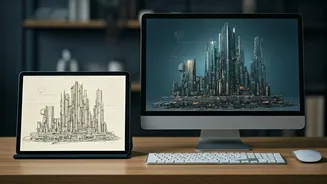
While Midjourney is a prominent player, the landscape is expanding rapidly. Several platforms are integrating this conceptual leap into their workflows. Tools like Vizcom are tailored for industrial and product designers, allowing them to upload rough sketches and have the AI render them into photorealistic product shots in seconds. Krea AI offers a “live canvas” feature that morphs and adapts in real-time as you add new visual elements or text prompts, effectively acting as a dynamic, interactive mood board. Even established giants are getting in on the act. Adobe Firefly is being integrated across its Creative Suite, promising similar features that will allow designers to stay within their familiar software ecosystems while leveraging AI to accelerate brainstorming and concepting. The core idea is the same across all platforms: reduce the friction between abstract inspiration and tangible output.
Beyond Speed: The Real-World Impact
The most obvious benefit is speed. What used to take a junior designer half a day can now be explored in ten minutes. But the implications run deeper. This technology allows for an explosion of creative iteration. Instead of painstakingly developing one or two concepts, a designer can generate twenty variations in the time it used to take for one. This dramatically expands the creative territory you can cover at the start of a project. It also transforms client communication. It’s far easier to get stakeholder buy-in when you can move from a mood board to a concrete visual during a single meeting. This rapid visualization closes the gap of interpretation and ensures everyone is on the same page before significant resources are invested. It’s less about replacing creativity and more about eliminating the grunt work that stands in its way.
The Human Element Remains Crucial
Of course, there are caveats. The word “instantly” carries a lot of weight, but the results are rarely perfect on the first try. The AI can misinterpret nuance, blend concepts awkwardly, or produce visuals that feel generic or soulless. The output is only as good as the input, and more importantly, the curation that follows. The real skill is no longer just in creating the mood board, but in directing the AI, selecting the best-generated prompts, and artfully refining the results. The designer’s role shifts from being a manual renderer to a creative director. You are the one with the taste, the strategic understanding of the brand, and the vision. The AI is just an incredibly fast and talented intern that never needs to sleep. It can’t tell you *why* an idea works, but it can show you *what* it looks like faster than ever before.