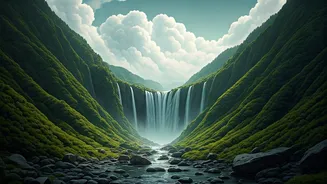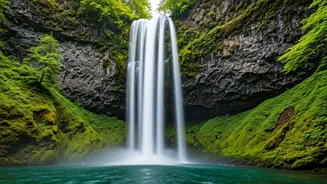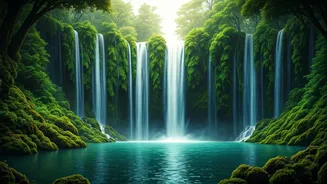


The Emerald Corridor: Columbia River Gorge, Oregon
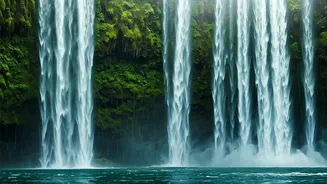
Nowhere is the “main character” energy of a waterfall more apparent than in Oregon’s Columbia River Gorge during its wet season, which stretches from late fall through spring. This isn’t a gentle drizzle; it’s a life-giving downpour that supercharges
the landscape. The iconic Multnomah Falls, a two-tiered behemoth, thunders with a force you can feel in your chest. But it’s the dozens of other falls that truly define the experience. Drive the Historic Columbia River Highway and you’ll pass one after another: Latourell Falls plunging onto basalt columns, Horsetail Falls cascading right near the road, and Wahkeena Falls creating a delicate, misty spray. The rain saturates everything, turning the moss a near-fluorescent green and filling the air with the smell of damp earth and cedar. This isn’t a trip for a sun-tan; it’s an immersive, moody experience where you feel like you’ve stepped into a fantasy novel.
The Misty Mountains: Western North Carolina
The southern Appalachians are old, gentle mountains, but in a downpour, they reveal a wilder side. The region around Asheville and Brevard, North Carolina—aptly located in Transylvania County, known as the "Land of Waterfalls"—is a prime destination for a rain-soaked adventure. Here, the experience is less about one single giant and more about the sheer abundance. After a heavy spring or summer rain, the Blue Ridge Parkway becomes a gallery of cascades. Water streams down every rock face. Trails lead to roaring spectacles like Looking Glass Falls, which you can admire from your car, or the more secluded Moore Cove Falls, where you can walk behind the curtain of water. The beauty here is in the atmosphere: the low-hanging clouds that shroud the peaks and the constant, soothing sound of rushing water that seems to emanate from the forest itself. It’s a peaceful, almost mystical, kind of power.
The Tropical Theater: Hāmākua Coast, Hawaiʻi
While not a traditional “monsoon,” the winter wet season on Hawaiʻi's Big Island offers a similar, if more tropical, transformation. The Hāmākua Coast on the island's northeastern side is a lush, dramatic landscape of deep valleys and sheer sea cliffs, and rain is what makes it all possible. This is where you find ʻAkaka Falls, which plummets 442 feet into a gorge so verdant it seems unreal. During the wet season, the volume of water is staggering. Nearby Rainbow Falls, in Hilo, is another must-see; on sunny mornings following a rainy night, the mist creates perfect rainbows at its base. A drive along the coast reveals countless other unnamed falls spilling directly into the turquoise Pacific. This isn't the gray, moody rain of the Pacific Northwest; it’s a warm, life-affirming downpour that makes the whole island feel more alive, painting the scenery in vibrant strokes of green and blue.
The Rainforest Cathedral: Olympic National Park, Washington
If you truly want to lean into a rainy getaway, go to the place that perfects it: Olympic National Park. This is one of the wettest places in the continental United States, and its temperate rainforests are designed for it. In the Hoh and Quinault Rain Forests, the trees are draped in thick coats of moss, and the forest floor is a carpet of ferns. When the rain comes, the entire ecosystem seems to hum with energy. The waterfalls here feel like sacred parts of a larger whole. Sol Duc Falls, for example, splits into multiple channels that pour into a narrow, dark canyon, creating a uniquely powerful roar. Marymere Falls, near Lake Crescent, is a graceful 90-foot drop that feels like a reward at the end of a beautiful, mossy trail. Visiting during the wet season means fewer crowds and a more profound connection to the raw, untamed spirit of the Pacific Northwest.