








Decoding Green Energy Funds
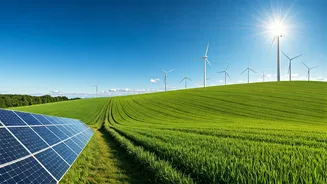
At its core, a green energy mutual fund is a professionally managed portfolio that pools money from many investors to buy stocks in companies operating in the renewable energy sector. Think of it as a basket filled with shares of businesses focused on solar,
wind, hydrogen, battery storage, electric vehicle infrastructure, and other clean technologies. This is a specific type of ESG (Environmental, Social, and Governance) investing, zeroing in on the 'E' for environmental impact. Unlike buying a single stock like Tesla, a mutual fund or its popular cousin, the Exchange-Traded Fund (ETF), provides instant diversification across dozens or even hundreds of companies. This spreads your risk; if one company in the fund underperforms, the success of others can help balance it out. These funds are designed to give everyday investors access to a sector that’s complex and capital-intensive, without needing to become an expert on photovoltaic cell efficiency or wind turbine manufacturing.
The Tailwinds Pushing Clean Power
The argument for investing in green energy isn't just about feeling good—it's increasingly about following the money. Several powerful forces are creating what investors call 'long-term tailwinds.' First, there’s massive government support. In the U.S., the Inflation Reduction Act (IRA) unlocked hundreds of billions in tax credits and incentives for clean energy production and adoption, creating a powerful and durable demand signal for the entire industry. Similar initiatives are underway globally. Second, the economics have fundamentally shifted. The cost of generating electricity from solar and wind has plummeted over the past decade, making renewables the cheapest source of new power in many parts of the world. Finally, both corporations and consumers are driving change. Major companies are making ambitious pledges to run on 100% renewable energy, creating a huge corporate market, while public demand for climate-friendly products and services continues to grow. These factors combine to create a compelling, multi-decade growth story.
A Sober Look at the Risks
While the long-term outlook is bright, the path to green equity wealth isn't a straight line. Green energy stocks can be notoriously volatile. As a niche sector, they are more susceptible to sharp swings than a broad market index like the S&P 500. Bad news—like a shift in government policy, supply chain disruption for key materials like lithium or silicon, or a competitor’s technological breakthrough—can hit these focused funds hard. Furthermore, many renewable energy companies are still in a high-growth, high-spend phase. They may not be consistently profitable, and their stock prices are often based on future potential rather than current earnings, making them sensitive to changes in interest rates. Higher rates make it more expensive for these companies to borrow money for new projects, which can dampen investor enthusiasm. Acknowledging this volatility is key; this is not a 'get rich quick' scheme but a long-term thematic bet.
Finding the Right Fit for Your Portfolio
So, how should you approach this? First, think of a green energy fund not as the foundation of your house, but as a new, high-tech room you’re adding on. For most investors, these thematic funds should be a 'satellite' holding, representing a smaller portion of a well-diversified portfolio that is still anchored by broad-market index funds. When evaluating specific funds, look beyond the name. Dig into the fund’s holdings. Is it concentrated in a few solar companies, or does it offer broader exposure across wind, energy storage, and smart grids? Check the expense ratio—the annual fee you pay for the fund's management—as lower fees can significantly boost your long-term returns. Finally, review its track record, but do so with the understanding that past performance is no guarantee of future results. The goal is to find a fund whose specific strategy and risk profile align with your own financial goals and tolerance for market ups and downs.