



The Most Expensive Drink in the Universe
To understand why space agencies are obsessed with water, you first need to understand the brutal economics of leaving Earth. Every single pound of material launched into orbit is subject to what engineers call the 'tyranny of the rocket equation.' In
simple terms, lifting mass costs a fortune in fuel. Launching a single 16-ounce bottle of water to the International Space Station can cost thousands of dollars. At that price, you’re not just carrying water; you’re carrying a liability. For decades, every mission had to pack all the water it would ever need for drinking, hygiene, and life support. This fundamentally limited the length and ambition of human spaceflight. If you have to bring your own water, you can only go as far as your cosmic moving van can carry. But what if you didn’t have to pack it? What if, instead of hauling it from Earth, you could find it waiting for you when you arrived?
A Gas Station in the Sky
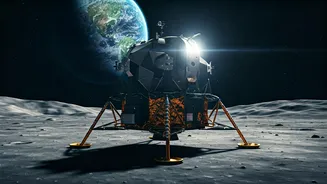
The single most revolutionary use for water in space has nothing to do with drinking it. It’s about turning it into rocket fuel. Water (H₂O) is made of hydrogen and oxygen. Using a simple process called electrolysis, powered by solar panels, you can split water molecules into their component parts. The result? Pure liquid hydrogen and liquid oxygen, which happen to be one of the most powerful and efficient rocket propellants known to science. Suddenly, a frozen crater on the Moon isn’t just a patch of ice; it’s a potential refueling station. Asteroids rich in water ice become orbiting gas stations. This concept, known as In-Situ Resource Utilization (ISRU), or 'living off the land,' changes the entire game. Instead of launching a massive, fully-fueled ship from Earth to get to Mars and back, you could launch a 'lighter' ship to the Moon, refuel, and then head to Mars. It makes deep space travel economically and logistically feasible in a way it has never been before.
A Shield, a Shelter, and a Breath of Air
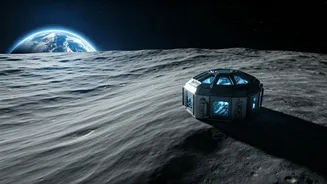
The benefits don’t stop at propellant. The oxygen produced from splitting water is, quite obviously, breathable air for future habitats. The hydrogen can be used in fuel cells to generate electricity during the long lunar nights. But one of the most elegant uses is also the simplest: the ice itself. Deep space is filled with harmful cosmic radiation. On Earth, our atmosphere and magnetic field protect us, but on the Moon or Mars, astronauts are exposed. It turns out that water is an excellent radiation shield. Its hydrogen-rich molecules are particularly good at stopping the high-energy particles that can damage human DNA. Future lunar or Martian bases could be built with thick walls of ice, or even constructed underneath surface ice, providing natural protection. Water can be the bricks and mortar of our first off-world homes, shielding us from the harshness of space while also providing the air we breathe and the fuel for our journeys.
Prospecting the Final Frontier
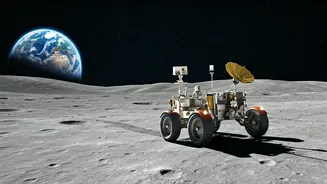
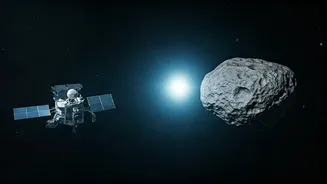
This isn't science fiction. We already know water is out there. Decades of research have confirmed vast deposits of water ice hidden in permanently shadowed craters at the Moon's poles—areas that haven't seen sunlight in billions of years. Mars has massive polar ice caps and evidence of buried glaciers. Even near-Earth asteroids, which are easier to reach than the Moon in some cases, are known to contain significant amounts of water ice. Missions are already being planned to map and eventually extract these resources. NASA's VIPER (Volatiles Investigating Polar Exploration Rover) is designed to prospect for ice at the lunar South Pole, effectively creating the first resource map of another world. Private companies are developing their own technologies, seeing a future where they can sell water and fuel in orbit to national space agencies and other customers. The 21st-century space race may not be about planting flags, but about prospecting for water.