


So, What Is Rath Yatra?
At its heart, Rath Yatra, or the 'Chariot Festival,' is one of the most important Hindu festivals, celebrated annually in the coastal city of Puri in the eastern state of Odisha. It commemorates the journey of Lord Jagannath—a form of the deity Vishnu—along
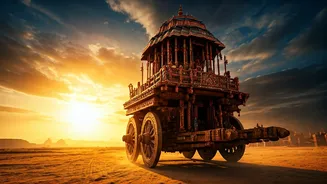
with his elder brother Balabhadra and sister Subhadra, from their home temple to their aunt's temple a couple of miles away. It's a symbolic trip representing a deity coming out to the public, offering blessings to all, regardless of caste or creed. But instead of a motorcade, this procession involves three colossal, intricately decorated wooden chariots, pulled not by engines, but by the sheer force of hundreds of thousands of devotees.
A Spectacle of Unfathomable Scale
Try to picture a million people. Now picture them all in one place, focused on one goal. That’s the starting point for Rath Yatra. The crowd is a sea of humanity, a vibrant, moving mosaic of faith. The chariots themselves are architectural marvels, rebuilt anew each year from specified woods according to centuries-old tradition. Lord Jagannath's chariot, Nandighosa, stands roughly 45 feet tall, with 16 massive wheels. These aren't parade floats; they are mobile temples, thundering through the streets of Puri, preceded by devotees dancing, singing, and chanting. It's a logistical and spiritual event on a scale that makes festivals like Mardi Gras or Carnival seem quaint by comparison. It’s less a parade you watch and more a human tide you become part of.
A Full-Body Sensory Experience
This isn't a silent, contemplative pilgrimage. Rath Yatra is a symphony for the senses, played at maximum volume. The air is thick with the sound of gongs, cymbals, and traditional drums, all competing with the roar of a million voices chanting 'Jai Jagannath!' ('Victory to Jagannath'). The visual is a riot of color: the brilliant reds, yellows, and blacks of the chariots’ canopies against the bright saris and dhotis of the crowd. The scent of incense and marigold garlands mixes with the salty air from the nearby Bay of Bengal. You don’t just see the festival; you hear it, feel it, and breathe it in. For any traveler seeking true immersion, this is the deep end.
The Ultimate 'Main Character' Moment
Here's where the 'Main Character Energy' truly comes into play. The massive chariots are moved by devotees who grab hold of thick, long ropes to pull them forward. This act is considered incredibly auspicious. It’s a moment of collective effort and personal devotion. You are not a passive observer behind a velvet rope. You are, potentially, one of the thousands of hands providing the power to move a god. This single act—of physically participating in a divine journey—is what elevates the experience from a tourist spectacle to a personal narrative. It's the feeling of being a vital part of something ancient, massive, and deeply meaningful. You are not just witnessing the story; you are helping to pull it along.