







A Heartbeat from the Void
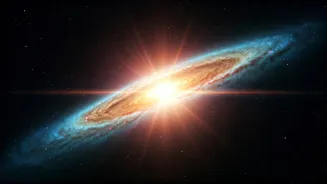
Imagine pointing a telescope at a distant galaxy and discovering it has a pulse. That’s essentially what a team led by MIT scientists has found. They've identified a supermassive black hole at the center of a galaxy, located a staggering 850 million light-years
from Earth, that is emitting a periodic flare of X-rays. This rhythmic burst, occurring roughly every 200 seconds, is so consistent that the research team has dubbed it a 'heartbeat.' This isn't just a random flicker; it’s a stable, repeating signal that has been pulsing for years. The discovery provides an unprecedented look into the chaotic environment right at the edge of a black hole, a region from which not even light can escape once it crosses the 'event horizon.' This heartbeat is our messenger from the abyss.
What Makes a Quasar 'Flicker'?
So, what's causing this cosmic metronome? The signal comes from a quasar, which is the intensely bright core of a galaxy powered by a supermassive black hole actively feeding on surrounding gas and stars. Think of it as the universe’s most extreme feeding frenzy. As material swirls around the black hole in a structure called an accretion disk, it gets superheated to millions of degrees, releasing an enormous amount of energy, including X-rays. The 'flickering' or 'heartbeat' observed by the MIT team is believed to be caused by a smaller, secondary object—perhaps a smaller black hole or a dense star cluster—that is orbiting the central supermassive black hole. With each pass, this object likely disturbs the accretion disk, creating a regular disruption that we see as a predictable spike in X-ray emissions. It's a gravitational dance on a scale almost too massive to comprehend.
An Unusually Stable Signal
While astronomers have detected similar quasi-periodic oscillations (QPOs) from black holes before, the signal from this particular galaxy system, known as ASASSN-14ko, is exceptional for its stability. Many such signals are transient, appearing and disappearing over time. This one, however, has been beating like a drum for at least eight years of observation. This long-term stability is a goldmine for astrophysicists. It allows them to study the physics of a black hole's immediate surroundings in a way that a fleeting signal never could. Dheeraj Pasham, the MIT research scientist who led the study, compared it to having a consistent lab experiment set up for you in space. The regularity of the heartbeat provides a fixed variable that can be used to measure other properties of the system, like the spin of the black hole and the size of its accretion disk.
A Window into the Cosmic Past
Here's where the sense of scale truly hits home. The headline says the object is 850 million years old, but it’s more accurate to say we are seeing it as it was 850 million years ago. Because the galaxy is 850 million light-years away, the light (and X-rays) carrying the information about this cosmic heartbeat has been traveling across the universe for that entire time. When this signal first began its journey toward Earth, the first complex animals were just beginning to evolve on our planet. We are, in effect, using telescopes as time machines. By studying this ancient system, scientists aren't just learning about black holes; they're learning about the universe as it existed in the distant past. This discovery offers a snapshot of how massive galaxies and the black holes at their centers behaved hundreds of millions of years ago, providing crucial data points for our models of cosmic evolution.